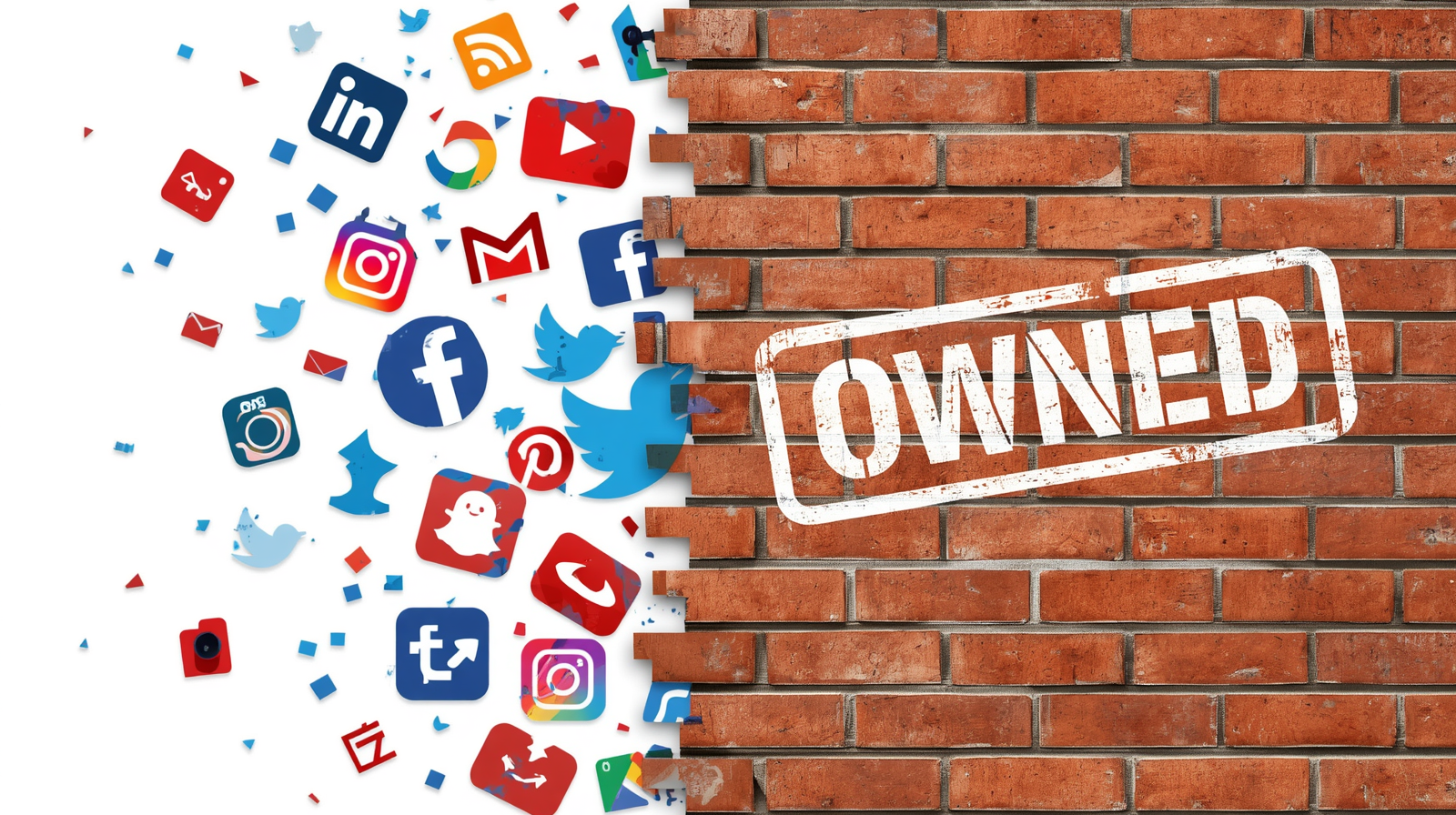
Your social media following is not your audience. It never was. Every follower you’ve earned on Instagram, LinkedIn, or Facebook belongs to the platform — not to you. One algorithm change, one policy update, or one account suspension, and that connection vanishes overnight. That’s the uncomfortable reality thousands of SMBs are confronting in 2026, and the ones moving fastest are the ones building something that no platform can take away.
First-party data — the information you collect directly from your customers through channels you own — has become the defining competitive advantage for small and mid-sized businesses right now. Not because it’s a trend, but because every other option is getting less reliable, more expensive, and increasingly subject to forces outside your control.
This post breaks down exactly what first-party data means for an SMB with limited time and resources, why the window to act is narrowing, and the practical steps you can take to start building an audience you own — one that compounds in value every month. You’ll also see how Q’dUp’s on-site production model is specifically designed to build that owned asset library from day one.
The Hidden Cost of Renting Your Audience
Think about what it means to have 5,000 Instagram followers versus 5,000 email subscribers. With Instagram, your posts are seen by roughly 1-2% of your audience on any given day — a figure that Hootsuite’s 2026 organic reach analysis confirms has dropped from 16% back in 2012. LinkedIn organic reach has slid 34% year over year. Instagram’s declined 12%. These aren’t minor fluctuations — they represent a systematic reduction in what you get for free.
With 5,000 email subscribers, you reach virtually all of them when you send. You don’t need to pay for boosted posts to stay visible. You’re not at the mercy of a recommendation engine that doesn’t know your business. The difference between these two scenarios is the difference between renting and owning — and the ROI gap reflects it clearly: email consistently returns between $36 and $42 for every dollar spent, compared to social media’s roughly $2.80.
The platform dependency problem is intensifying, not easing. Third-party cookies — the invisible infrastructure that allowed advertisers to track users across websites and retarget them with precision — have been progressively dismantled across major browsers. Safari and Firefox blocked them years ago. Chrome followed with its Privacy Sandbox shift. The era of borrowing someone else’s data to reach your own customers is ending.
What First-Party Data Actually Means for Your SMB
First-party data is every piece of customer information you gather through your own touchpoints: website visits, email sign-ups, form fills, purchase history, content downloads, and event registrations. You collect it, you store it, and critically, you own it. No platform can restrict access to it, and no privacy regulation eliminates it because consent was given directly to you.
According to TechRT’s 2026 first-party data report, 75% of brands are actively working to phase out their reliance on third-party data this year. Email newsletters are the single most popular collection method, used by 63% of advertisers. Content marketing — blogs, video series, podcasts — drives first-party data growth for 53% of businesses. That number matters for every SMB already investing in content.
Beyond first-party data, the smartest marketers are building zero-party data strategies. This goes one layer deeper: it’s information your customers intentionally share with you — their preferences, purchase intentions, and communication preferences — through surveys, quizzes, and preference centers. ADV.me’s 2026 zero-party data playbook reports that businesses making this transition are seeing 40-60% higher conversion rates on outbound campaigns.
The practical takeaway is that owning your data doesn’t require a massive tech stack. It starts with a deliberate decision to treat every piece of content you create as an audience-building asset — not just a scheduled post.
The Five Owned-Audience Channels Every SMB Should Build
1. Your Email List: The Asset No Algorithm Can Touch
An email list is the purest form of audience ownership. Every subscriber has opted in, confirmed they want to hear from you, and given you direct access to their inbox. Compass Digital’s owned-audience analysis puts it plainly: when you rely on social platforms, you’re renting reach. When you own an email list, you control distribution outright. Growing this list requires giving people a genuine reason to subscribe. Lead magnets — checklists, templates, how-to guides, short video series — convert casual visitors into subscribers with measurable intent.
2. Your Website and Blog: The Hub You Control
Every blog post, service page, and resource library you build on your own domain is an asset in your owned media portfolio. Traffic driven there is yours to convert, retarget, and analyze. IM Applied SEO’s 2026 guide to SME first-party data strategies identifies website analytics as the foundation of any first-party data program — contributing to over 60% of structured customer data collection. A robust blog with embedded video and podcast content signals multi-modal authority across both traditional and AI-driven search.
3. Podcast and Video Libraries
Video and audio content published under your own brand — a YouTube channel, your website, a podcast feed — becomes evergreen owned media. Interviews, how-to series, and client story features generate search-discoverable assets that continue working long after they’re published. Someone who subscribes to your podcast has actively signaled ongoing interest, and that behavioral data is trackable through your own analytics without relying on third-party tracking infrastructure.
4. CRM and Customer Data Platforms
Every purchase, every support interaction, every survey response builds a richer picture of who your customers are. A CRM like HubSpot or Salesforce centralizes this data and makes it actionable for segmented campaigns, personalized follow-ups, and lifecycle marketing. Companies winning right now are integrating their CRM with content performance data to understand which formats and topics actually move buyers — not just generate pageviews.
5. Loyalty Programs and Community Spaces
Loyalty programs, member communities, and referral programs generate consistent first-party data through ongoing engagement. Participants self-select as your most invested audience segment, and the data they generate — redemption patterns, engagement frequency, referral behavior — is exclusively yours. Research cited by TechRT indicates 68% of companies already leverage loyalty programs as a primary first-party insights channel.
Content Is the Engine — Not Just the Output
Most SMBs treat content marketing as something they produce and publish. The shift separating the fastest-growing brands is treating every piece of content as an audience-acquisition vehicle. A blog post that ranks for a specific question doesn’t just generate a pageview — it creates an opportunity to collect an email address, prompt a CRM entry, or trigger a video subscription.
This is why the framework matters as much as the content itself. Before any piece is produced, the question should be: what owned-audience outcome is this designed to drive? That reframing changes everything from topic selection to CTA placement to the gating strategy for supporting assets.
Q’dUp’s on-site production model is built around this principle. When our team comes to your location for a 2-3 day shoot, every deliverable — the long-form video series, the podcast episodes, the short-form clips, the blog content, the social assets — is designed to contribute to your owned asset library. Not platform-dependent reach. Not borrowed visibility. Real assets that build your audience data with every view, click, and download.
The Adtelligent analysis of marketing readiness for a cookieless world found that only about 15% of global marketers felt fully prepared for the privacy-first landscape. Nearly 90% reported shifting budgets toward first-party data strategies in anticipation. SMBs who act now will have a structural advantage over competitors still relying on rented audiences when platforms tighten further.
Three Mistakes SMBs Make With Audience Data
- Treating social follower counts as a success metric. Follower numbers measure platform reach, not owned audience size. Addictive Digital’s 2026 organic reach study confirms that Facebook page posts now reach under 2.2% of followers without paid amplification — making those numbers largely decorative.
- Creating content without a data capture mechanism. A blog post with no email opt-in, a video with no subscription prompt, a webinar with no follow-up sequence — these miss the opportunity to convert audience interest into owned contacts.
- Relying on a single owned channel. Email lists can be compromised, domains can expire, YouTube channels have been terminated. Diversify across email, SMS, CRM, community spaces, and your own website so no single point of failure can sever your audience connection.
Making the Case Internally: The ROI Framework
For SMB owners who need to justify the shift from social-first to owned-audience-first, the ROI case is straightforward. HelloBar’s 2026 email vs. social comparison confirms that Facebook’s organic reach has declined from 16% in 2012 to approximately 1-2% today — while email continues delivering $36-$42 in return per dollar invested. Instagram’s organic reach dropped 12% year over year; LinkedIn’s slid 34%.
These numbers have a compounding effect over time. Every month a business invests in owned-audience channels, the gap between what they can reach for free versus what their social-first competitors can reach grows wider in their favor. It’s not about abandoning social media — it’s about using it as the top of a funnel that ends in owned data, not borrowed reach.
| AI Insight: AI-powered search engines — Google AI Overviews, Perplexity, ChatGPT — increasingly surface content from brands with deep, multi-format owned media libraries. Sites that combine video, audio, and written content are being prioritized over text-only pages. SMBs building owned asset libraries through consistent on-site production aren’t just protecting their audience — they’re positioning themselves as the authoritative sources that AI search engines cite and amplify. First-party data and AI-search visibility are now the same strategic investment. |
FAQ: First-Party Data Strategy for Small Businesses
How can small businesses build and own their audience without relying on social media platforms?
Start with an email list and a content-rich website. Every blog post, video, and podcast episode should include a clear reason for visitors to subscribe or share their information. Use lead magnets — downloadable checklists, templates, mini-courses — to incentivize sign-ups. Social media then works as a distribution channel that drives traffic back to assets you own, rather than serving as the destination itself.
What is first-party data and why does it matter for my small business in 2026?
First-party data is any customer information you collect directly — email addresses, purchase history, website behavior, survey responses. It matters because you own it outright: no algorithm can suppress it, no platform policy can restrict your access, and no privacy regulation eliminates relationships you built with full consent. It’s the most reliable foundation for sustainable audience growth.
Is email marketing still effective for small businesses in 2026?
Absolutely — and it’s widening its lead over social media. Email delivers $36-$42 for every dollar spent on average, while social media averages roughly $2.80. More importantly, email reaches your full list without algorithmic interference. As organic social reach continues declining across Facebook, Instagram, and LinkedIn, email’s direct-delivery advantage becomes more valuable each year.
What is zero-party data and how is it different from first-party data?
Zero-party data is information your customers intentionally share with you — their preferences, communication frequency preferences, product interests — through interactive tools like quizzes, preference centers, and surveys. First-party data is collected passively through your tracking systems. Zero-party data captures declared intent, making it more accurate for personalization and more resilient against future privacy restrictions.
How does content marketing help build first-party data for SMBs?
High-quality content drives traffic to your owned channels and gives visitors a reason to exchange their contact information for something of value. How-to video series, expert blog posts, and downloadable frameworks all create natural opt-in moments. When your content is genuinely useful, building your email list and CRM database becomes a natural byproduct of showing up consistently. Content marketing drives first-party data collection for 53% of businesses according to current industry data.
Your Audience Should Be an Asset, Not a Liability
The businesses that will lead their markets over the next five years are not the ones with the biggest social followings. They’re the ones with the deepest owned audiences — email subscribers who open every send, CRM records rich with behavioral data, video subscribers who show up for every new release, and podcast listeners who treat each episode as a priority.
Building that foundation takes consistent, high-quality content that gives people a genuine reason to stay connected. Treating every content piece as an audience-building vehicle — not just a scheduled post — is what separates compounding audience growth from the content treadmill. The difference in outcomes over 12-24 months is substantial.
Q’dUp is an award-winning content marketing agency. Our on-site production model brings our team directly to your business location, where we capture 3-4 months of video, podcast, blog, and social media content in just 2-3 days of focused recording. Every deliverable is engineered to build your owned audience library — not to generate platform-dependent impressions that vanish the moment you stop posting.
| Ready to build an audience you actually own? Book a complimentary Q’dUp strategy session. Our award-winning team comes to your location and captures 3-4 months of owned-audience content — video, podcast, blog, and social assets — in just 2-3 days of on-site recording. Every asset is built to compound your first-party data and audience growth with every view, click, and download. Limited strategy sessions available. Book Your Session. |