
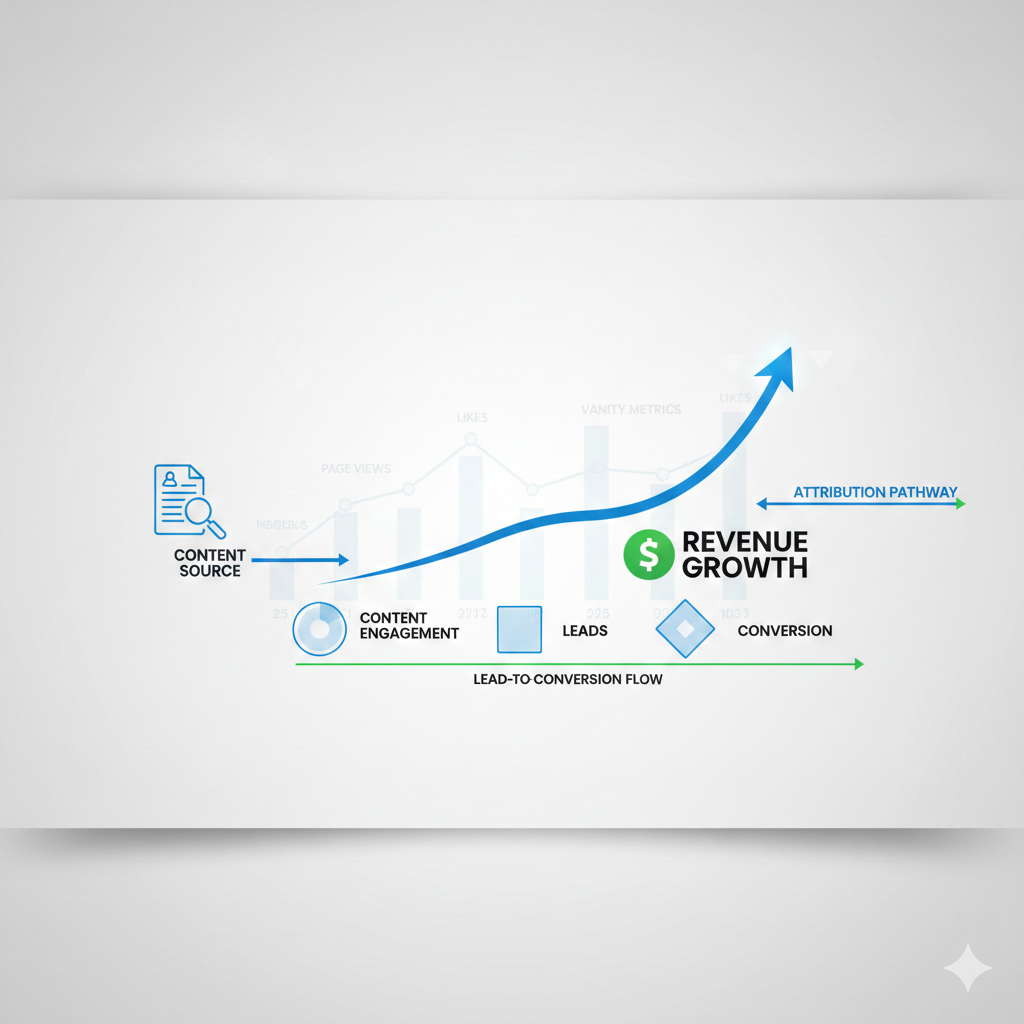
Your video got 50,000 views last month. Your podcast downloads doubled. Your blog traffic is soaring. Congratulations—you’re officially measuring the wrong things.
Here’s the uncomfortable truth most SMB marketing managers don’t want to hear: vanity metrics are killing your content ROI. While you’re celebrating engagement rates and time-on-page benchmarks, your competitors are tracking the metrics that actually predict revenue. According to HubSpot’s 2026 State of Marketing Report, 40% of marketers now prioritize lead quality and marketing qualified leads as their most important success metric—the highest of any measured category.
The shift isn’t subtle. Modern content marketing has moved beyond surface-level engagement to revenue attribution, customer acquisition costs, and lifetime value calculations. SMB decision-makers can no longer afford to celebrate metrics that don’t connect directly to business outcomes.
This guide reveals which content metrics actually drive revenue growth, how to implement proper measurement frameworks, and why most SMBs are tracking activity instead of impact. By the end, you’ll know exactly which numbers matter—and which ones are wasting your time.
Why Most Content Metrics Miss the Revenue Mark
Walk into any SMB marketing meeting and you’ll hear the same metrics: website traffic increased 23%, social media engagement jumped 47%, email open rates hit 34%. Everyone nods approvingly. Nobody asks the critical question: “How much revenue did we generate?”
This measurement disconnect stems from a fundamental misunderstanding of what drives business growth. Content Marketing Institute’s 2025 research found that while 74% of marketers say content marketing helped generate demand and leads, only 49% can definitively connect it to sales revenue. The gap between activity and impact has never been wider.
The problem intensifies when SMBs rely exclusively on platform-provided analytics. YouTube views, Instagram impressions, and LinkedIn engagement metrics create the illusion of progress while masking revenue reality. These vanity metrics answer “how many?” but ignore “how valuable?” A thousand podcast downloads means nothing if none convert to consultation bookings. Ten thousand blog visitors deliver zero ROI if they’re the wrong audience entirely.
Research from HubSpot’s 2026 State of Marketing reveals another crucial insight: 56% of marketers say it’s easier to improve conversion rates now than a decade ago, yet 30% still report generating quality leads as a top challenge. This paradox exists because teams optimize for the wrong conversion points. They celebrate email signups without tracking which subscribers actually purchase. They measure content consumption without connecting it to customer acquisition.
The measurement problem extends beyond simple tracking errors. According to Content Marketing Institute’s 2025 B2B research, 56% of marketers struggle with attribution challenges when trying to connect content touchpoints to pipeline influence. Traditional last-click attribution dramatically undervalues content that educates prospects early in their journey, while multi-touch models require sophisticated tracking systems most SMBs lack.
Perhaps most damaging: SMBs waste resources creating content optimized for metrics that don’t matter. When your primary goal is maximizing views, you create clickbait. When obsessing over engagement rates, you prioritize entertainment over education. Neither approach drives revenue. Both consume budget that could fund content actually connecting to business outcomes.
The solution isn’t abandoning engagement metrics entirely—it’s understanding which metrics predict revenue and which simply measure activity. Leading SMBs have already made this shift, focusing measurement on customer acquisition cost, lifetime value ratios, and content-influenced pipeline. The businesses still celebrating vanity metrics? They’re the ones wondering why content budgets face constant scrutiny despite “impressive” performance numbers.
The Revenue-Driving Metrics Framework That Actually Matters
Modern content measurement requires a fundamental framework shift: from consumption metrics to conversion economics. Here’s what SMBs must track to connect content directly to revenue.
Lead Quality Score and Marketing Qualified Leads (MQLs)
According to HubSpot’s 2026 State of Marketing Report, 40% of marketers now rank lead quality and MQLs as their most important metric—higher than any other measurement category. This isn’t accidental. Quality trumps quantity in every revenue calculation.
Tracking MQL conversion rates reveals which content actually attracts your ideal customer profile. Your webinar generated 500 registrations, but how many fit your buyer persona? How many requested demos? HubSpot’s research found that 77% of marketers rated their lead quality as high or very high in 2026, yet implementing proper scoring systems separates the 23% still struggling with lead qualification.
Content-Influenced Pipeline and Revenue Attribution
Multi-touch attribution modeling answers the critical question: which content pieces actually contribute to closed deals? According to SQ Magazine’s November 2025 content marketing research, 42% of brands now use attribution modeling to connect content touchpoints with pipeline influence—essential for proving content ROI.
Revenue attribution requires tracking every piece of content prospects consume before purchasing. Did they read three blog posts before booking a consultation? Watch your product demo video? Download a comparison guide? Map these touchpoints to understand which content drives decisions versus which simply fills time.
Customer Acquisition Cost (CAC) by Content Channel
HubSpot’s 2026 data reveals that 30% of marketers track customer acquisition cost as a top metric, yet many fail to segment CAC by content type. Calculate the total investment (creation, distribution, promotion) divided by customers acquired through each channel. Your podcast might generate fewer leads than paid ads, but if CAC is 60% lower, it’s your most profitable channel.
SMBs often discover their highest-traffic content has the worst CAC ratios. Blog posts generating 10,000 monthly visitors but zero qualified leads represent wasted investment, regardless of engagement metrics. Meanwhile, that technical whitepaper with just 200 downloads might deliver your lowest CAC if it attracts decision-makers ready to buy.
Conversion Rate by Funnel Stage
According to Statista’s 2025 research, the average e-commerce conversion rate across all sites sits below 2%. But that aggregate number masks critical funnel stage variations. Track conversion rates at each stage: visitor to lead, lead to MQL, MQL to sales-qualified lead (SQL), SQL to customer.
Even small improvements compound dramatically. Increasing top-of-funnel conversion from 2% to 2.8% while simultaneously improving MQL-to-SQL rates from 30% to 40% can double your customer acquisition volume without increasing traffic. Email marketing, which HubSpot research shows drives 2.8% conversion rates for B2C and 2.4% for B2B, demonstrates how channel-specific optimization delivers measurable revenue impact.
Content Influence on Closed Deals
Only 29% of organizations currently track content influence on closed deals using CRM and marketing automation integrations, according to SQ Magazine’s analysis. This represents the most direct revenue measurement possible: which specific pieces of content appear in the journey of customers who actually purchased?
Tracking content influence reveals unexpected insights. Your most-viewed blog post might contribute to zero closed deals while a technical specification sheet appears in 73% of winning opportunities. These insights reshape content strategy from popularity contests to revenue engines.
Lifetime Value (LTV) to CAC Ratio
Ultimate content ROI measurement requires comparing customer lifetime value against acquisition cost. Content that attracts customers with 3X higher LTV justifies higher CAC—and deserves more investment. Conversely, content driving high-volume, low-value customers requires strategy recalibration regardless of impressive vanity metrics.
According to Averi AI’s Content Marketing ROI research, high-performing B2B SaaS companies use LTV:CAC ratios to guide content investment decisions, recognizing that customer value varies dramatically by acquisition source. Your gated whitepaper might generate fewer leads than your weekly newsletter, but if those leads convert at twice the rate and carry 40% higher lifetime value, it’s your most valuable content asset.
Time to Revenue
How long from first content interaction to closed deal? Shorter sales cycles reduce carrying costs and improve cash flow. HubSpot’s research reveals video content delivers ROI 49% faster than text-based content for companies needing quicker returns. Understanding time-to-revenue by content type helps SMBs optimize for both immediate impact and long-term value.
This metrics framework transforms content from a cost center to a revenue driver. Each metric connects directly to business outcomes, making content budget allocation strategic rather than speculative.
Implementing Revenue-First Content Measurement
Transitioning from vanity metrics to revenue measurement requires systematic implementation. Follow this framework to build measurement infrastructure that actually drives business decisions.
Establish Unified Tracking Architecture
Begin by connecting your content management system, CRM, and analytics platforms. Without integration, attribution remains impossible. According to Genesysgrowth’s ROI research, CRM data must connect with analytics platforms for accurate revenue attribution—a capability 44% of marketers still lack.
Set up UTM parameters for every content piece. Tag blog posts, videos, podcasts, social media posts, and email campaigns with consistent naming conventions. This foundational step enables tracking which specific pieces contribute to conversions. Most SMBs skip this crucial setup, then wonder why they can’t prove content ROI.
Define Clear Attribution Models
Choose attribution models matching your sales cycle complexity. Simple B2C transactions with short consideration periods work well with last-touch attribution. Complex B2B sales requiring multiple touchpoints need multi-touch or position-based models. According to HubSpot’s 2026 research, 38% of B2B marketers now prioritize conversion rate per content piece, requiring attribution models showing exactly which content drives those conversions.
Test multiple attribution approaches simultaneously. Compare results from first-touch, last-touch, linear, and time-decay models. Different models reveal different insights—first-touch highlights top-of-funnel content effectiveness while last-touch shows bottom-funnel conversion drivers.
Implement Lead Scoring Systems
Not all leads equal revenue potential. Develop scoring systems assigning point values based on demographic fit (company size, industry, role) and behavioral engagement (content consumed, pages visited, resources downloaded). HubSpot research found 77% of marketers report high lead quality, but proper scoring separates qualification from guesswork.
Assign higher scores to content consumption indicating purchase intent. Someone downloading your pricing comparison guide demonstrates stronger intent than someone reading a general industry trends post. Weight your scoring accordingly, then track which content types generate highest-scoring leads.
Set Stage-Specific Conversion Benchmarks
Establish baseline conversion rates for each funnel stage, then optimize systematically. According to research analyzed by Averi AI, strengthening collaboration between marketing and sales teams while refining lead scoring systems directly boosts MQL-to-SQL conversion rates—the critical middle-funnel stage most SMBs neglect.
Monitor conversion rate trends monthly. If visitor-to-lead rates improve but MQL-to-SQL rates decline, your content attracts interest without qualifying properly. If SQL-to-customer rates lag despite strong MQL generation, your content educates but doesn’t address decision-stage objections. Each conversion stage reveals different content optimization opportunities.
Build Revenue Dashboards
Create executive dashboards showing content’s direct revenue contribution. According to SQ Magazine’s research, scroll depth tracking has become a standard analytics layer used by 47% of marketers to assess content depth performance—but that metric only matters if correlated with conversion outcomes.
Include metrics executives actually care about: revenue influenced by content, customer acquisition cost by channel, content ROI by format, pipeline contribution from organic versus paid content. Replace “10,000 blog visitors this month” with “blog content contributed to 23 closed deals worth $547,000 in new revenue.”
This implementation framework transforms content measurement from reporting activities to proving business impact. The shift requires initial setup investment, but the ROI clarity it provides makes content budgets defensible rather than discretionary.
How Q’dUp’s Data-Driven Approach Maximizes Content ROI
Q’dUp Content Marketing Agency built its entire service model around the metrics that actually matter. While many content agencies celebrate production volume and engagement rates, Q’dUp focuses exclusively on the measurements that connect to client revenue growth.
The agency’s unique on-site content creation model delivers a critical measurement advantage: concentrated production efficiency that dramatically reduces customer acquisition costs. By capturing 3-4 months of professional content in just 2-3 days of on-site recording, Q’dUp eliminates the inefficiencies that inflate traditional content CAC calculations. SMBs aren’t paying for drawn-out monthly retainers or endless revision cycles—they’re investing in a focused production sprint that yields measurable returns.
This efficiency extends beyond production costs to measurement clarity. When Q’dUp creates comprehensive content libraries during intensive on-site sessions, tracking becomes straightforward. Every video, podcast episode, and social media asset originates from that concentrated production period. Attribution is clean. ROI calculations are precise. There’s no confusion about which content drove which outcomes because the entire library stems from a single, focused engagement.
Q’dUp’s award-winning production quality amplifies these measurement advantages. According to HubSpot’s research, video content delivers ROI 49% faster than text-based content. Q’dUp specializes in creating the exact content formats—professional video and podcast productions—that compress sales cycles and accelerate time-to-revenue. When SMB clients can demonstrate faster deal velocity alongside reduced acquisition costs, content budgets transform from marketing expenses to strategic revenue investments.
The agency’s approach also addresses the attribution challenges plaguing most content marketing. Rather than scattering budget across disconnected tactics with murky attribution, Q’dUp’s on-site model creates cohesive content ecosystems. When prospects engage with multiple pieces from the same professional library—watching an explainer video, listening to a podcast episode, downloading a case study—the attribution path becomes crystal clear. This integrated approach delivers the multi-touch attribution insights that 42% of brands now use to connect content with pipeline influence.
Most importantly, Q’dUp’s model aligns perfectly with how modern buyers actually make decisions. HubSpot’s 2026 research reveals that nearly 70% of marketers report leads arriving later in the buying process after conducting AI-assisted research. Prospects consume substantial content before ever contacting sales. Q’dUp’s comprehensive content libraries support this self-directed research journey while maintaining measurement clarity throughout.
For SMB marketing managers tired of celebrating vanity metrics while questioning content ROI, Q’dUp offers a refreshingly direct alternative: professional content creation that tracks directly to revenue outcomes, produced with the efficiency and quality required to actually move business metrics that matter.
This Week’s AI Insight: Content Metrics and Revenue Attribution
AI is fundamentally reshaping how marketers measure content performance and attribute revenue—but not in ways most SMBs expect. According to the Interactive Advertising Bureau’s State of Data 2026 report released February 7, 2026, up to 75% of marketers report that current attribution systems, incrementality tests, and marketing mix models underperform on rigor, timeliness, trust, and efficiency. Despite widespread adoption, these advanced measurement approaches fail to deliver the insights needed to justify spending and guide optimization.
Here’s the opportunity: 50% of marketers currently scale AI within their measurement frameworks, with more than 70% of those not yet scaling expecting to do so within one to two years. AI enables more sophisticated attribution approaches, with marketers anticipating that omnichannel lift tests and multi-touch attribution will soon become as accessible as today’s simpler first-touch or last-touch methods.
The cautionary note matters equally. Half of marketers anticipate that legal and security risks, accuracy concerns, and data quality issues will create significant challenges with AI-powered measurement. The technology promises to unlock approximately $26 billion in media investment value and $6 billion in productivity gains, but only for organizations implementing AI responsibly with clear governance frameworks.
For SMB marketers, the strategic imperative is clear: AI measurement tools amplify rather than replace human strategic thinking. The businesses winning with AI-powered attribution maintain rigorous data quality standards, implement proper validation protocols, and use AI to accelerate insights—not automate blind optimization. Measurement remains fundamentally about connecting content to revenue outcomes. AI simply makes those connections faster and more accurate when implemented thoughtfully.
Source: Interactive Advertising Bureau State of Data 2026: The AI-Powered Measurement Transformation
Frequently Asked Questions About Content Metrics and Revenue
Which metrics should SMBs prioritize when content budgets are limited?
Focus on three core measurements: customer acquisition cost (CAC) by content channel, lead-to-customer conversion rate, and lifetime value (LTV) of customers acquired through content. These metrics directly connect content investment to revenue outcomes. Track which specific content pieces appear in the journey of customers who actually purchased—this content influence data reveals what’s working versus what’s consuming budget without returns. 40% of marketers now prioritize lead quality over volume, making conversion efficiency more critical than raw traffic numbers.
How long before content marketing shows measurable revenue impact?
Content marketing typically requires 3-6 months to demonstrate meaningful ROI, with different formats delivering returns at different speeds. HubSpot’s research shows video content delivers ROI 49% faster than text-based content, while comprehensive SEO strategies may require 6-9 months to reach full potential but provide compound returns for years. The key is tracking early indicators—lead quality scores, engagement from target personas, progressive conversion rate improvements—rather than waiting for closed deals before evaluating content effectiveness.
What’s the difference between vanity metrics and revenue metrics?
Vanity metrics measure activity without connecting to business outcomes: page views, social media followers, email open rates, podcast downloads. Revenue metrics track economic impact: customer acquisition cost, conversion rates by funnel stage, content-influenced pipeline, lifetime value ratios. According to Content Marketing Institute’s 2025 research, 74% of marketers say content helped generate demand, but only 49% can connect it definitively to sales revenue. The difference between these percentages represents the vanity metric gap—teams celebrating activity without proving impact.
How can small businesses implement attribution tracking without enterprise tools?
Start with basic UTM parameters on all content links, tracking which specific pieces drive conversions in Google Analytics. Connect your email marketing platform and CRM to see which content leads consume before purchasing. Even simple spreadsheet tracking showing “customers who consumed X content had Y% higher conversion rates” provides attribution insights without requiring expensive marketing automation platforms. According to research, 42% of brands use attribution modeling—but sophisticated isn’t necessary. Consistent tracking beats complex systems most SMBs won’t maintain.
Should SMBs still track engagement metrics if they don’t directly drive revenue?
Track engagement metrics as leading indicators, not success measures. Time on page, scroll depth, and video completion rates predict conversion potential—someone watching your entire product demo likely represents higher intent than someone bouncing after 15 seconds. But according to SQ Magazine’s research, only 47% of marketers use scroll depth tracking, and far fewer correlate it with conversion outcomes. Engagement metrics gain value when analyzed alongside conversion data, revealing which engagement patterns predict purchases. Isolated from revenue outcomes, they remain vanity metrics regardless of how impressive the numbers appear.
Moving Beyond Vanity Metrics to Revenue Reality
The content marketing measurement revolution isn’t coming—it’s already here. While some SMBs continue celebrating views and engagement rates, leading organizations have shifted entirely to revenue-focused metrics frameworks. Customer acquisition costs, lifetime value calculations, content-influenced pipeline, and attribution modeling now dominate strategic conversations because they actually predict business growth.
This measurement transformation requires more than new dashboards. It demands fundamental mindset shifts from activity tracking to outcome measurement, from consumption metrics to conversion economics, from celebrating what’s easy to measure toward proving what actually matters. The businesses making this transition successfully share three characteristics: integrated tracking infrastructure connecting content to revenue, attribution models revealing which content drives decisions, and leadership commitment to measuring impact over activity.
For SMB marketing managers questioning content ROI while leadership scrutinizes budgets, the solution isn’t producing more content or chasing higher engagement rates. It’s implementing revenue-first measurement proving exactly which content drives customer acquisition and at what cost. According to HubSpot’s 2026 research, 56% of marketers report it’s easier to improve conversion rates now than a decade ago. The tools, frameworks, and best practices exist. The question is whether you’ll continue measuring what’s comfortable or start tracking what counts.
Q’dUp’s on-site content creation model exists precisely to solve this measurement challenge. By producing comprehensive content libraries during focused production sprints, eliminating traditional agency inefficiencies, and delivering the professional quality that actually converts prospects, Q’dUp makes content ROI demonstrable rather than speculative. When marketing budgets face pressure and content effectiveness comes under scrutiny, measurement clarity becomes competitive advantage.
Ready to transform content from a cost center to a revenue driver?
Book a complimentary strategy session where we’ll analyze your current content performance, identify which metrics actually matter for your business, and show you how Q’dUp’s award-winning on-site production model delivers the measurement clarity and conversion efficiency your content strategy demands. Limited February strategy sessions available—secure your spot today.