
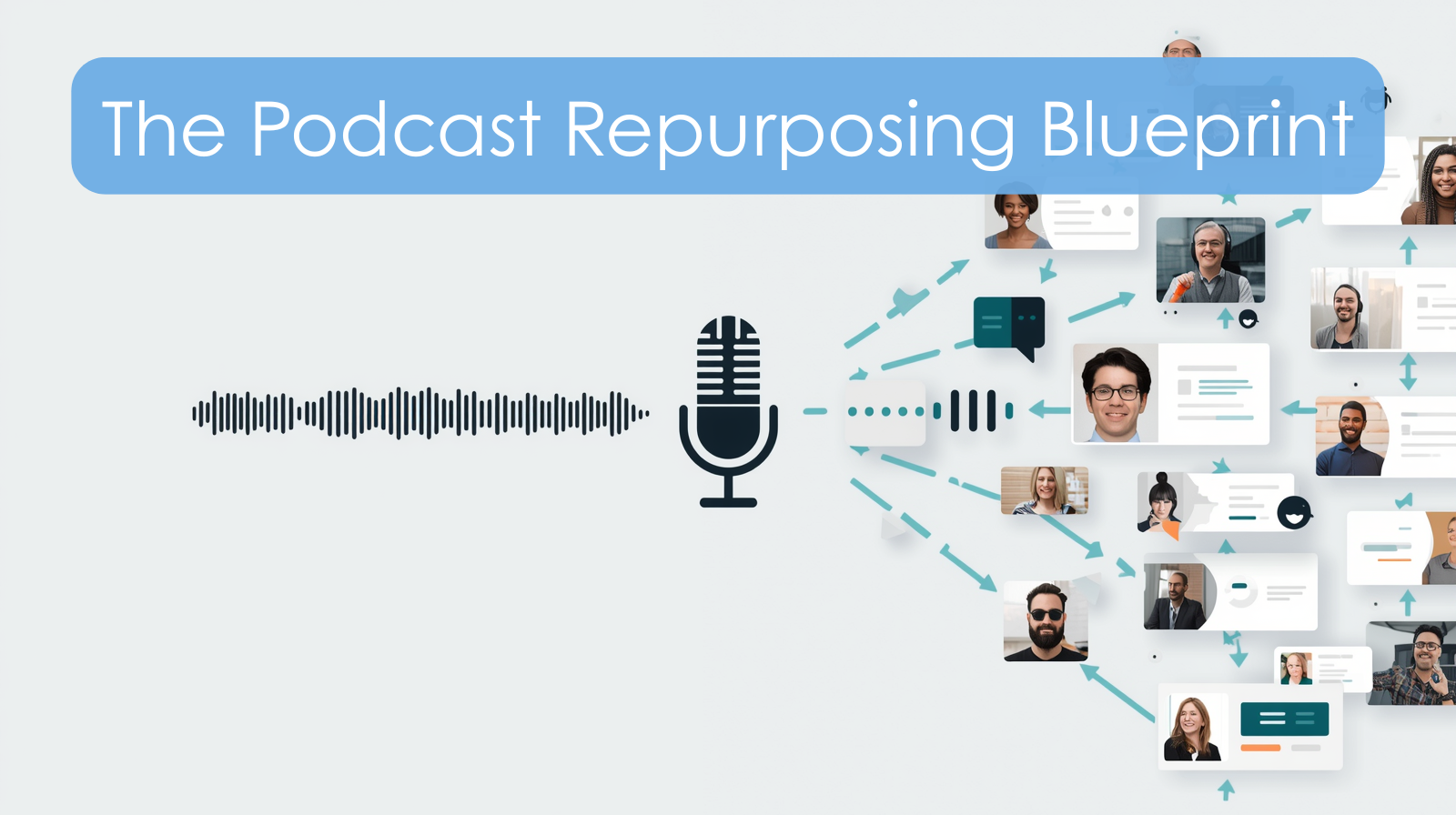
Every Episode Is Worth More Than You Think
You recorded a solid podcast episode last week. Maybe it was 35 minutes of genuine insight, practical advice, and real conversation. Your editor cleaned it up, you published it on Spotify and Apple, and now it’s sitting there — waiting to be discovered by listeners who may never find it.
That’s the costly reality most SMBs face with podcasting in 2026. The investment in recording, editing, and publishing is real. But the return is often limited because businesses treat their podcast as a single-format asset instead of what it actually is: a content engine capable of fueling weeks of marketing across every major channel.
The good news? A clear repurposing blueprint changes everything. According to a year-end report from CoHost, over 584 million listeners worldwide tuned into podcasts in 2025 — and brands that built multi-format distribution strategies around their episodes consistently outperformed those publishing audio only. This guide breaks down exactly how SMBs can unlock that full value in 2026, and why professional production is the foundation that makes it all possible.
📬 Get Weekly SMB Content Strategy Tips
Join thousands of SMB owners receiving Q’dUp’s Wednesday content marketing insights. Subscribe to our newsletter →
Why SMBs Are Leaving Revenue on the Table
Most small businesses invest significant time and money in podcast production — and then distribute a single audio file. That’s the equivalent of filming a television commercial and only airing it once at 2 AM. The asset exists; it just isn’t being leveraged.
The Real Cost of One-and-Done Publishing
Consider what goes into a single 30-minute episode: research and prep time, scheduling a guest, recording, editing, and publishing. For most SMBs, that represents 4 to 8 hours of effort. When that episode lives only as audio on a single platform, the return on that investment is dramatically undercut by distribution limits.
Contrast that with a repurposing strategy. The same 30-minute episode — when processed through a structured workflow — can generate a written blog post, 8 to 12 short-form social video clips, a LinkedIn article, an email newsletter, pull-quote graphics, a YouTube video, and searchable show notes. The research from SQ Magazine confirms this math: content repurposing strategies improve ROI by 32% on average compared to single-format publishing.
Where SMBs Get Stuck
The barrier isn’t motivation — it’s process. Most SMB owners know they should be repurposing content. The challenge is that manual repurposing is time-intensive. Clipping a 30-minute episode, writing captions for each clip, reformatting for Instagram versus LinkedIn versus YouTube Shorts, and then scheduling it all across platforms can take 5 to 8 hours per episode. Without a defined system, it simply doesn’t happen.
That’s where professional production and structured workflows close the gap — and where AI tools are beginning to play a meaningful supporting role.
The 2026 Repurposing Blueprint: A Five-Layer System
Effective podcast repurposing isn’t random. It follows a deliberate hierarchy — from the core long-form asset down through increasingly concise formats — each layer serving a distinct audience segment and platform. Here’s the system Q’dUp recommends for SMB clients.
Layer 1 — The Core Asset: Your Full Episode
Everything begins with a high-quality recording. This is non-negotiable. Poor audio quality, inconsistent lighting on a video podcast, or weak production values undermine every derivative asset downstream. A professional recording session — captured with proper equipment, in a controlled environment — produces source material that can be repurposed for 90 days or more.
Q’dUp’s on-site production model is built around this principle. Our team spends two to three days at a client’s location, recording professional video and podcast content in volume. The result is 3 to 4 months of high-quality source material from a single production investment — material ready to be distributed and repurposed across every layer below.
Layer 2 — Long-Form Written Content: Blog Posts and Articles
Every episode contains enough substantive content for one or two full blog posts. The key is not simply publishing a transcript — that approach provides minimal SEO value and a poor reading experience. Instead, extract the core insights, restructure them as standalone written content with a clear introduction, actionable takeaways, and a conclusion, and optimize for your target keywords.
A 35-minute conversation about customer retention strategies becomes a 1,500-word guide on “How SMBs Can Improve Customer Retention Without Increasing Ad Spend.” That blog post is searchable, shareable, and positions your brand as a thought leader — while driving traffic back to the original episode.
This approach also serves your SEO directly. Google indexes text, not audio. Converting your episode insights into written content is one of the most effective ways to expand your organic search footprint without creating entirely new ideas.
Layer 3 — Short-Form Video: Social Clips and Reels
Short-form video is where podcast content reaches the broadest new audience in 2026. Platforms including Instagram Reels, TikTok, YouTube Shorts, and LinkedIn video all favor concise, high-value clips — and your podcast episodes are full of them.
The goal at this layer is identifying the three to five most compelling moments from each episode: a surprising insight, a counterintuitive statement, a memorable analogy, or a clear piece of actionable advice. Each moment becomes a 60- to 90-second clip, captioned and formatted for vertical viewing.
💡 Q’dUp Tip
One professionally produced podcast episode can yield 8 to 12 short-form social clips. That’s 8 to 12 opportunities to reach new audiences who would never search for your podcast directly — but who will stop scrolling for a compelling 60-second video in their feed.
Layer 4 — Email and Newsletter Integration
Your email list is the most direct channel to your existing audience — and podcast content integrates naturally. Each episode provides a newsletter hook: tease the three biggest insights from this week’s episode, link to the full recording, and include one actionable tip extracted from the conversation.
This approach increases episode listens among subscribers, keeps your newsletter content fresh without requiring original writing each week, and reinforces your expertise on a consistent cadence. For SMBs building long-term audience trust, this consistency compounds over time.
Layer 5 — Platform-Specific Long-Form: YouTube and LinkedIn
Video podcast episodes published to YouTube serve a dual purpose: they capture the growing segment of podcast listeners who prefer visual formats, and they benefit from YouTube’s search algorithm — a search engine second only to Google in global traffic volume.
According to CoHost’s 2025 Podcasting Unwrapped report, one-third of U.S. listeners now discover podcasts through YouTube — making it the top platform for podcast discovery. SMBs that publish their video episodes on YouTube with optimized titles, descriptions, and chapters are effectively running a second search engine strategy from the same recorded content.
LinkedIn long-form articles serve a similar function for B2B-focused SMBs. A conversation you had on your podcast about leadership, business operations, or industry trends can be reframed as a LinkedIn article — reaching professional audiences who are actively consuming industry content on the platform.
Building Your Repurposing System: The Practical Workflow
A repurposing strategy only works if it’s systematic. Ad hoc repurposing — clipping a video when you remember, writing a blog post if time allows — produces inconsistent results and eventually fades out. The blueprint below creates a repeatable weekly rhythm.
Week 1: Record and Produce
This is the foundation layer. Focus entirely on capturing high-quality content. For SMBs working with Q’dUp, this happens during your on-site production session where our team handles all technical aspects — audio, lighting, camera, and post-production — so you focus only on the conversation.
If you’re producing independently, invest in quality before quantity. A professional microphone, proper acoustic treatment, and consistent lighting for video will pay dividends across every repurposed asset. One well-produced episode is worth more than five mediocre ones.
Week 2: Distribute the Core Asset
Publish your episode to all audio platforms — Spotify, Apple Podcasts, Amazon Music, and iHeart. Simultaneously publish the video version to YouTube with chapter markers, a keyword-optimized description, and a custom thumbnail. Write and publish your show notes as a dedicated web page, including a transcript, three key takeaways, and links to resources mentioned.
These show notes matter more than most SMBs realize. Search engines can index your episode’s content through the written show notes page, making your conversation discoverable to anyone searching the topics you discussed — even people who have never listened to a podcast.
Week 3: Activate Short-Form Distribution
Review the episode and identify your best moments. Clip 8 to 12 short segments of 60 to 90 seconds. Caption each one, format for vertical viewing, and schedule across Instagram, TikTok, LinkedIn, and YouTube Shorts throughout the week. Space them out — two to three clips per week extends your episode’s social media presence across three to four weeks of content.
This is one area where AI tools are genuinely helpful. Tools like OpusClip and similar platforms can identify strong clip candidates automatically, generate captions, and handle basic formatting — tasks that previously required hours of manual editing. However, editorial judgment still matters. AI identifies candidates; you decide which clips actually represent your brand well and align with your audience’s interests.
Week 4: Publish Written and Email Content
Convert the episode’s core insights into a standalone blog post. Avoid simply reformatting the transcript — rewrite the content as an article that stands on its own, adding context, formatting it for readability, and optimizing for your target keywords. This written content serves both current audiences and the organic search traffic that will discover it months from now.
Send your newsletter featuring the episode. Include three key insights, a link to the full recording, and one immediately actionable tip extracted from the conversation. Keep it concise — the goal is to drive episode listens, not to replace the episode with a summary.
Why Professional Production Is the Multiplier
Every layer of this repurposing system depends on the quality of the original asset. An episode with audio issues, inconsistent sound levels, distracting background noise, or poor video lighting produces clips and derivative content that reflect those problems. Professional production isn’t a luxury — it’s what makes the repurposing math work.
Q’dUp’s on-site podcast production approach is designed specifically around this repurposing model. Our team arrives at your location and captures multiple episodes — typically enough for a full quarter of content — in a two-to-three day session. Every recording is produced to broadcast quality: clean audio, professional lighting, and camera setups that work across both horizontal (YouTube, TV) and vertical (Reels, Shorts) formats.
For SMBs, this model solves two persistent challenges simultaneously. First, the production quality barrier is removed — you’re not trying to build a recording studio or master editing software. Second, the content volume challenge is resolved — recording in batches means you always have polished source material ready to repurpose, even during your busiest seasons.
🤖 This Week’s AI Insight: Podcast Repurposing in the AI Era
AI is reshaping podcast repurposing in ways that are genuinely useful for SMBs — but the results depend heavily on what you put in. According to the CoHost 2025 Podcasting Unwrapped Report, AI has become a “full-time co-producer” for many creators, automating transcription, clip identification, and caption generation. Separately, the State of AI in B2B Video report found that 88% of B2B marketers now use AI for video tasks including automated editing, transcriptions, and generating clips — with more than 40% reporting time savings of at least three hours per episode. For SMBs, these efficiency gains are meaningful: time saved on mechanical tasks can be redirected toward the creative and strategic decisions that actually differentiate your content. The important caveat is that AI tools excel at pattern recognition and formatting, not editorial judgment. An AI can identify which segment of your podcast has the highest audio energy — but only you know whether that segment reflects your brand authentically and serves your audience’s actual needs. The SMBs seeing the best results in 2026 are treating AI as a production assistant with significant capabilities, not as a replacement for the human expertise that makes their content worth repurposing in the first place.
Source: CoHost, 2025 Podcasting Unwrapped: A Year in Review (December 2025) — https://www.cohostpodcasting.com/resources/podcasting-unwrapped-2025
Frequently Asked Questions
How many pieces of content can one podcast episode realistically produce?
A well-produced 30-to-45-minute episode can generate a full-length blog post, 8 to 12 short-form social clips, a YouTube video, email newsletter content, show notes, and platform-specific long-form articles. Most SMBs working with a defined repurposing system extend each episode across three to four weeks of consistent content across multiple channels.
Do I need professional production equipment to start repurposing content?
You don’t need a full studio, but audio quality matters significantly. Poor recording quality produces derivative content that reflects those problems. A quality USB microphone and basic acoustic treatment can suffice for early-stage podcasts. Businesses serious about repurposing at scale typically benefit from working with a professional production partner who captures broadcast-quality source material that performs well across every repurposing format.
How does podcast repurposing improve my SEO and search visibility?
Google indexes text, not audio. Converting your episode insights into written content — blog posts, show notes, YouTube descriptions, and LinkedIn articles — expands your organic search footprint without requiring you to generate entirely new ideas. Each written asset targets different search queries related to your episode topics, compounding your search visibility over time.
How is Q’dUp’s approach to podcast repurposing different from doing it in-house?
Q’dUp’s on-site production model captures 3 to 4 months of high-quality source material in a two-to-three day session — eliminating the ongoing time burden of individual recording sessions. More importantly, professional production quality ensures that every downstream repurposed asset performs at its best. In-house production often produces content that requires significant cleanup before it’s ready to repurpose, adding hours to the workflow.
What platforms should SMBs prioritize when distributing repurposed podcast content?
The right platforms depend on where your audience spends time, but YouTube is universally valuable because it functions as a search engine for video content. LinkedIn works well for B2B-focused SMBs. Instagram and TikTok reach broader consumer audiences through short-form clips. Email remains the highest-converting distribution channel for your existing audience. A strong repurposing system covers all of these from a single recording.
Is AI content repurposing a replacement for professional production?
No — and this distinction matters. AI tools are effective at automating time-intensive tasks like transcription, caption generation, and initial clip identification. They save real time. But AI cannot substitute for quality source material: it cannot fix poor audio, improve weak lighting, or add the editorial judgment required to identify which content moments best represent your brand. Professional production and AI repurposing tools are complementary, not competing approaches.
When should an SMB consider partnering with a content production agency?
The right time is when the gap between the content you’re producing and the content you need to compete is growing faster than your internal capacity to close it. If you’re consistently behind on publishing, struggling with production quality, or leaving recorded content unused because the repurposing workflow is overwhelming, a production partnership typically delivers a strong ROI by resolving all three problems simultaneously.
Key Takeaways: Your 2026 Repurposing Action Plan
- Every podcast episode has five distinct layers of repurposable content — audio, video, written, email, and social — and capturing all five is what separates a content strategy from a content library.
- Professional production quality at the source determines the ceiling on every downstream asset. Invest there first.
- A systematic weekly workflow — rather than occasional repurposing — is what produces consistent, compounding results across channels.
- YouTube is now the #1 podcast discovery platform in the U.S., making video podcast production a strategic priority, not an optional add-on.
- AI repurposing tools are genuinely useful for efficiency, but require human editorial judgment to ensure output aligns with your brand and audience.
- SMBs that capture 3 to 4 months of content in a single professional production session eliminate the biggest barrier to consistent publishing: ongoing production burden.
🎙️ Ready to Turn Your Podcast Into a Content Engine?
Book a complimentary 30-minute strategy session. We’ll review your current podcast approach and show you how Q’dUp’s on-site production model can deliver 3 to 4 months of repurposable content in just a few days. Limited sessions available — schedule yours today. Book Your Free Strategy Session →