Every week, another AI tool promises to revolutionize your content marketing. The pitches are polished, the demos are compelling, and the entry-level pricing feels accessible. Yet small business owners are right to ask the sharper question: which tools actually move the needle on revenue and reach?
The answer is that most AI content tools deliver genuine value—when selected and deployed with a clear workflow in mind. The problem isn’t the technology itself. It’s the tendency to adopt hype-driven platforms without testing them against real business goals, to stack tools without a coherent system, and to skip the human oversight that separates useful AI-assisted content from generic filler.
This guide cuts through the noise. Below are seven AI tools that SMBs are using right now to produce better content in less time—with measurable returns to back it up. You’ll also learn where each tool belongs in your production workflow and, critically, what each one cannot do without a skilled human in the loop.
📚 Want weekly AI content marketing insights you can actually use?
Subscribe to the Q’dUp newsletter and get practical guidance every Wednesday—no fluff, no filler.
→ Subscribe at qd-up.com
Why the Right AI Stack Matters for SMBs in 2026
The AI content marketing landscape has matured quickly. According to HubSpot’s 2026 State of Marketing Report, 94% of marketers plan to use AI in their content creation processes this year, and small businesses are 23% more likely than average to see strong ROI from blog-driven content strategies. That data point reflects a genuine shift: SMBs have moved past experimentation and into weekly workflow integration.
But here’s the important caveat: adoption without strategy produces commodity content. AI writing tools trained on the same public data tend to generate eerily similar outputs when left unchecked. The businesses winning in 2026 are using AI to handle structure, research efficiency, and production speed—then layering in authentic brand voice, real expertise, and original perspective that no model can replicate.
The seven tools below were selected on one criterion: demonstrated, measurable value for SMBs across content creation, distribution, and optimization. Each section covers what the tool does well, where human judgment stays non-negotiable, and how to fit it into a lean content operation.
The 7 AI Tools That Actually Deliver ROI
1. Claude (Anthropic) — Strategic Content Development
Best for: Long-form blog posts, brand voice consistency, content strategy documents
Claude has emerged as a preferred AI writing assistant for content marketers who need more than a rough-draft generator. Its capacity to maintain consistent brand voice across extended documents—and to work from complex strategic inputs before producing output—makes it particularly effective for SMBs creating weekly blog content, service page copy, and thought leadership pieces.
Where it delivers ROI: Claude excels at drafting 2,000–2,500 word blog posts with logical structure, nuanced tone, and coherent argumentation. For SMBs publishing weekly, this can compress content production from a full workday to two to three focused hours—time that gets redirected toward client relationships, sales conversations, or strategic planning.
Critical caveat: Every output requires a human review pass for factual accuracy, brand-specific claims, and current statistics. Treat it as a high-quality first-draft partner, not a final-draft publisher. AI hallucination of statistics is a real risk that only manual verification eliminates.
Learn more: claude.ai
2. Descript — Video and Podcast Editing at Scale
Best for: Podcast editing, video repurposing, transcript-based content creation
Descript approaches audio and video editing the way a word processor handles text. Edit a podcast or video by editing the transcript—cut a sentence on the page, and the corresponding audio or video disappears from the recording. For SMBs managing regular podcast or video content without a dedicated editor, this changes the production math entirely.
The platform’s filler-word removal, speaker identification, and AI voice correction features reduce post-production time significantly. Each edited transcript also becomes an instant foundation for blog drafts, show notes, or social captions—transforming a single recording session into multiple content assets without proportional additional labor.
Where it delivers ROI: Q’dUp’s on-site content creation model captures three to four months of video and podcast material in just a few days of recording. Descript is a key post-production tool for converting that raw footage into polished, distributable assets efficiently.
Learn more: descript.com
3. OpusClip — Short-Form Video from Long-Form Recordings
Best for: Repurposing podcast episodes, webinars, and long-form video into platform-ready social clips
Short-form video now ranks as the top ROI-driving content format among marketers, with 49% identifying it as their highest-performing format according to HubSpot’s 2026 State of Marketing data. OpusClip makes that format accessible for SMBs without dedicated social media video editors.
The platform’s AI identifies the most compelling moments in long recordings—quotable insights, clear takeaways, strong questions and answers—then packages them as platform-optimized clips for TikTok, Instagram Reels, YouTube Shorts, and LinkedIn. Automated captions and aspect ratio adjustments come with each clip.
One full recording session becomes ten to fifteen social clips. For SMBs already investing in video or podcast production, this represents pure ROI multiplication with minimal additional labor.
Learn more: opus.pro
4. Perplexity AI — Research and Fact-Checking
Best for: Content research, source verification, competitive analysis, current statistics
Content credibility is the currency of 2026. The wave of AI-generated material flooding the web has made original, sourced, and fact-checked information the primary differentiator between content that earns citations and content that gets ignored or penalized by search algorithms.
Unlike general-purpose AI assistants that sometimes generate plausible-sounding but fabricated citations, Perplexity functions as a cited search engine—delivering answers with linked, verifiable sources. For SMB content teams, it compresses research from hours of browser-tab management into focused, cited summaries.
Where it delivers ROI: Every Q’dUp blog post requires 10 to 15 verified external links from authoritative sources. Perplexity significantly accelerates the source-identification phase of that work—without replacing the critical human step of opening each URL to verify content and publication date before linking.
Learn more: perplexity.ai
5. Canva AI — On-Brand Visual Content Creation
Best for: Blog hero images, social media graphics, presentation design, brand-consistent visual assets
Every blog post needs a hero image. Every social clip needs a thumbnail. Every email needs a header graphic. For SMBs without a dedicated designer, Canva’s AI-integrated platform closes the visual content gap without the cost of outsourced design work.
Canva’s Brand Kit stores your colors, fonts, and logo assets—ensuring that AI-generated design suggestions land within your brand identity rather than producing generic stock-art results. The Magic Resize feature automatically adapts any design to every platform’s specification, eliminating the tedious manual reformatting that consumes production hours.
Technical note: Hero images must meet web performance standards before upload. Q’dUp’s spec: 1200×630px, WebP format, under 200KB after compression. Canva exports require a separate compression step—tools like TinyPNG handle this in seconds.
Learn more: canva.com/ai-assistant
6. Surfer SEO — Content Optimization for Search Visibility
Best for: Real-time SEO content scoring, keyword density analysis, competitive content benchmarking
Producing strong content that no one discovers is one of the most expensive and common SMB content mistakes. Surfer SEO bridges the gap between content quality and search visibility by analyzing the top-ranking pages for your target keyword and delivering data-driven recommendations for your own content.
The platform scores drafts in real time—flagging keyword density issues, missing related terms, heading structure gaps, and content length variances relative to what is currently performing. For SMBs targeting specific local or industry keywords, this eliminates guesswork from the optimization process.
Where it delivers ROI: A Semrush study analyzing over 10 million keywords found that pages maintaining strong traditional organic search signals are 25% more likely to appear in AI Overviews—the AI-generated summaries now appearing in roughly 15% of Google searches. SEO optimization in 2026 serves both traditional search and AI-powered discovery simultaneously.
Learn more: surferseo.com
7. Castmagic — Maximum Value from Every Recording
Best for: Podcast and video repurposing, show notes, social posts, email content, blog drafts from a single source
Castmagic may be the most underrated tool in the SMB content stack. Feed it a podcast episode or video recording, and it produces show notes, social media posts, email newsletter content, quotable pull quotes, and blog article drafts—all from the same source asset, without additional recording or writing sessions.
For businesses that record content but struggle to repurpose it consistently, Castmagic removes the primary bottleneck: converting audio into written assets manually. A single hour-long recording can generate a full week’s worth of content across multiple channels.
This directly supports Q’dUp’s core model. When a client records three to four months of content during two to three days of on-site production, Castmagic becomes the distribution multiplier that extends the reach and lifespan of every asset captured during those sessions.
Learn more: castmagic.io
How to Build Your Stack Without Overspending
The goal is not to subscribe to all seven tools at once. Most SMBs operate lean content operations, and tool sprawl creates its own inefficiency—more subscriptions, more logins, more context-switching, less mastery of any single platform. Consider building your stack in phases tied to your current content priorities.
Phase 1: Foundation (Months 1–2)
- Claude — primary content drafting, strategy documents, and brand voice work
- Perplexity — research acceleration and source verification
- Canva AI — visual assets that stay on-brand without a dedicated designer
Phase 2: Video and Audio Activation (Months 2–4)
- Descript — essential once you’re producing podcast or regular video content
- OpusClip — to repurpose long-form recordings into social clips efficiently
- Castmagic — to extract maximum content value from every recording session
Phase 3: Optimization Layer (Month 3+)
- Surfer SEO — add once content is publishing consistently and you’re ready to optimize for search performance and AI citation potential
This phased approach controls costs, builds workflow competency before adding complexity, and ensures each tool demonstrates value before the next is added. Canceling underperforming subscriptions is far easier when you’ve added tools deliberately rather than all at once.
The Human Oversight Principle: What AI Cannot Replace
The 2026 content marketing landscape rewards a specific combination: AI efficiency paired with human differentiation. Tools accelerate production. Humans provide the original perspective, verified accuracy, brand judgment, and authentic voice that makes content worth reading—and worth ranking.
Three areas where human oversight is non-negotiable:
- Fact verification. Even strong AI tools can fabricate statistics, misattribute sources, and present outdated data confidently. Every external link in published content must be manually fetched and verified against the actual source before the post goes live.
- Brand voice and positioning. AI reflects patterns in training data and produces competent, generic content. The specific expertise, real client stories, and market perspective that differentiate your brand must be injected by humans at the editing stage.
- Strategic judgment. AI executes content strategy. It cannot evaluate whether the strategy is right for your market, your audience, and your business goals at this specific moment. That judgment belongs to you.
Businesses that thrive in this environment use AI to eliminate the production bottleneck—and invest the recovered time into original thinking, real client relationships, and strategic clarity that no model can provide.
How Q’dUp Integrates AI into the On-Site Production Model
Q’dUp’s approach to AI-assisted content production is intentionally hybrid. AI tools support research, post-production, and content repurposing workflows. The recording sessions themselves—the conversations, the interviews, the authentic moments of real expertise—remain fully human.
This distinction matters because authenticity is both an audience expectation and an AI search ranking signal. Google’s E-E-A-T framework (Experience, Expertise, Authoritativeness, Trustworthiness) rewards content demonstrating genuine human knowledge and experience. A podcast episode featuring a business owner’s perspective on their industry satisfies those signals in ways that purely AI-generated content cannot.
Q’dUp’s on-site production model captures three to four months of content in two to three days—video, podcast, and raw material for blog posts, social clips, and email content. AI tools then multiply the reach of that authentic foundation, repurposing recorded conversations into content assets across every platform where your audience spends time.
The result is content that feels human because it is human, distributed at scale because AI handles the reformatting, optimization, and scheduling that would otherwise consume your team’s creative time.
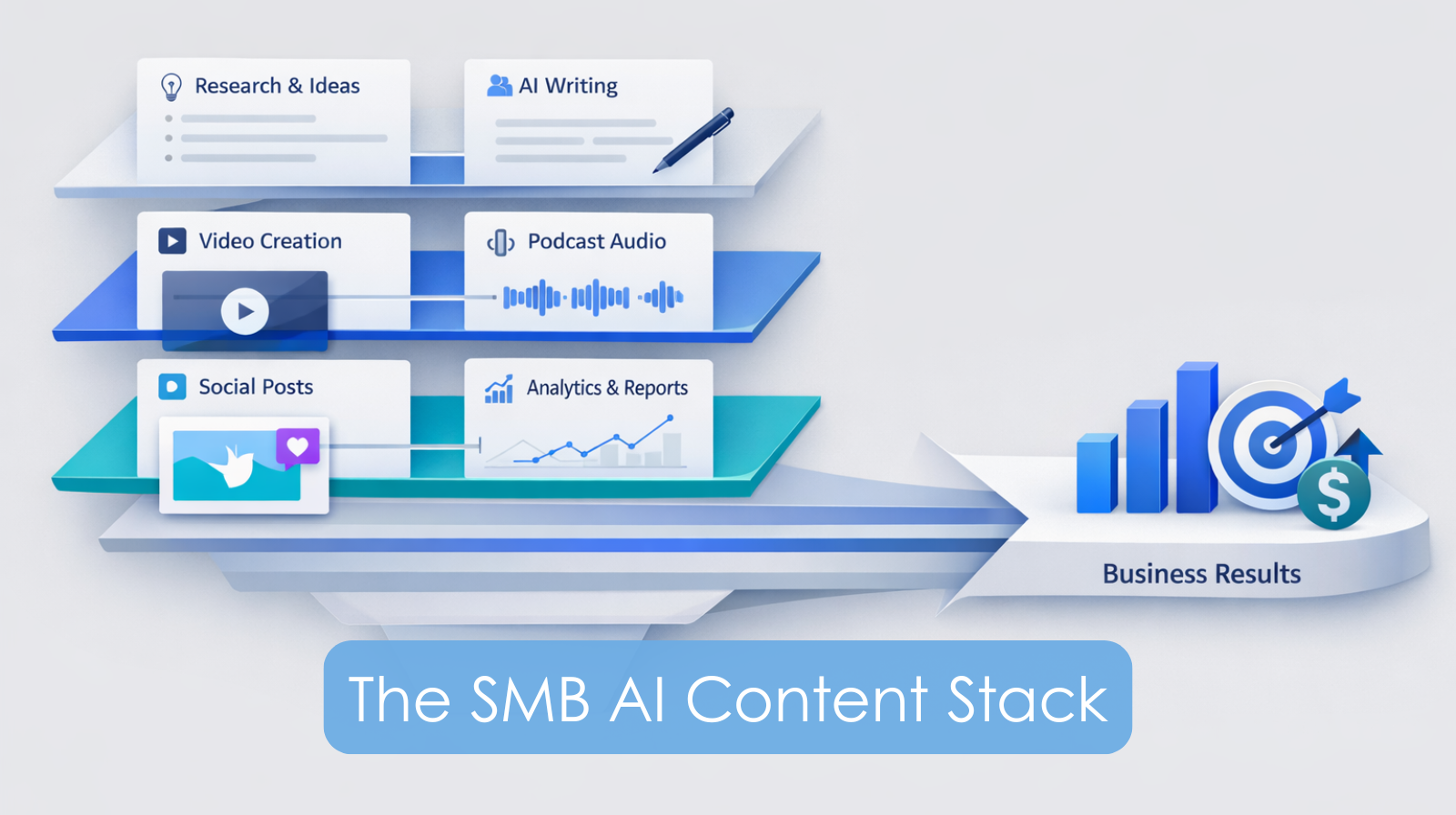
This Week’s AI Insight: Building an AI Content Stack for SMBs
AI is restructuring how small businesses create and distribute content—but the ROI gap is widening between strategic adopters and tool collectors. HubSpot’s 2026 State of Marketing data shows small businesses are 23% more likely than average to see strong content marketing ROI, with 94% of marketers now planning to use AI in creation workflows this year. Separate Semrush research found that 68% of businesses report measurably higher content marketing ROI specifically from AI tool adoption. Yet the caution worth holding alongside those numbers: the majority of AI marketing implementations still require meaningful human oversight to reach performance benchmarks. For SMBs, this means the stack itself is less important than the discipline around it—verified sources, authentic brand voice, and human editorial judgment applied at every stage. AI compresses production timelines and multiplies content assets. Human expertise provides the differentiation that makes those assets worth consuming and worth citing.
Sources: HubSpot 2026 Marketing Statistics | Semrush Content Marketing Statistics
Frequently Asked Questions
What is the best AI tool for small business content marketing in 2026?
There is no single best answer—it depends on your current content mix. For SMBs just starting with AI, Claude for writing and Perplexity for research form a strong foundation. Businesses already producing video or podcast content should prioritize Descript and OpusClip to maximize the ROI of existing recordings before adding other tools.
How much do these AI content tools typically cost per month?
Most tools in this stack offer SMB-accessible pricing. Claude Pro runs approximately $20 monthly; Descript’s Creator plan starts around $24; Canva Pro is roughly $15; OpusClip and Castmagic offer entry-level plans in the $17–$29 range; and Surfer SEO starts at approximately $89 monthly. A strategically built stack of two to four tools delivers significant production leverage for under $100 per month—a fraction of what outsourcing equivalent work would cost.
Can AI tools replace a content marketing agency or team?
No—and the most successful SMBs are not trying to make that substitution. AI tools handle structural production tasks: drafting, reformatting, scheduling, and optimizing. Strategy, brand voice, audience understanding, and authentic expertise still require human professionals. The strongest use of AI is to amplify a lean team’s output, not eliminate the team.
How do I know if my AI-generated content is accurate before publishing?
Assume it may not be—and verify accordingly. Every statistic, external link, and factual claim in AI-generated content should be manually checked against the original source before publication. Broken links, fabricated statistics, and misattributed research damage both credibility and SEO performance simultaneously. This verification step is non-negotiable, not optional.
How does Q’dUp use AI in its content production process?
Q’dUp uses AI in pre-production research, post-production editing, and content repurposing—not during the recording sessions themselves. On-site recording captures authentic conversations, real expertise, and genuine brand voice. AI then helps repurpose those recordings into blog posts, social clips, show notes, and email content efficiently. This hybrid model produces content that performs in AI-powered search because it demonstrates genuine human experience and expertise at its core.
Key Takeaways
- AI tools deliver measurable ROI when chosen strategically—not when adopted indiscriminately in response to marketing hype.
- The highest-impact foundational stack for most SMBs: Claude for writing, Perplexity for research, Descript and OpusClip for video and podcast repurposing, Canva AI for on-brand visuals.
- Human oversight at three critical points is non-negotiable: fact verification, brand voice, and strategic judgment.
- Short-form video repurposed from long-form recordings now ranks as the top ROI-producing content format, making tools like OpusClip and Castmagic high-value investments for any business already recording.
- AI compresses production timelines. It cannot replace the authentic human expertise that makes content worth discovering, worth trusting, and worth sharing.
Ready to Build a Content Stack That Actually Works?
Q’dUp’s on-site production model captures 3–4 months of authentic video, podcast, and content marketing assets in just 2–3 days on location. Our team integrates AI tools throughout post-production and distribution—so your content performs across every platform where your audience spends time.
Book a complimentary 30-minute strategy session. We’ll audit your current content operation and show you exactly where AI tools can accelerate your ROI without compromising the authenticity your audience expects.
→ Schedule your session at qd-up.com/contact
Repurposing Recommendations
Video Series
- “The AI Writing Tool Showdown: Claude vs. ChatGPT vs. Jasper for SMBs”
- “How to Edit a Podcast Episode in 30 Minutes Using Descript”
- “We Turned One Recording Session into 15 Content Pieces — Here’s How”
Podcast Episode
- Title: “The Honest SMB Guide to AI Content Tools: What’s Worth Paying For in 2026”
- Angle: Invite a Q’dUp client to share their real experience integrating AI tools after an on-site production session
Email Newsletter
- Subject: “The 7 AI tools we actually recommend (and the ones we skip)”
- Format: Condensed tool comparison table with a one-sentence ROI summary per tool, linking to this full post
Every piece of content you record has a longer shelf life than you think. A single on-site session becomes a blog post, a podcast episode, a video series, a month of social clips, and an email campaign—when the right tools are in place to extract that value. That’s the real ROI case for building your AI content stack: not just producing faster, but getting more mileage out of every authentic moment you capture.
If you want to see what a fully integrated AI content stack looks like in practice—built around your brand, your audience, and your goals—book a free strategy session with the Q’dUp team. We’ll walk you through exactly how our on-site production model and post-production AI workflow can turn two or three days of recording into months of content that actually performs.