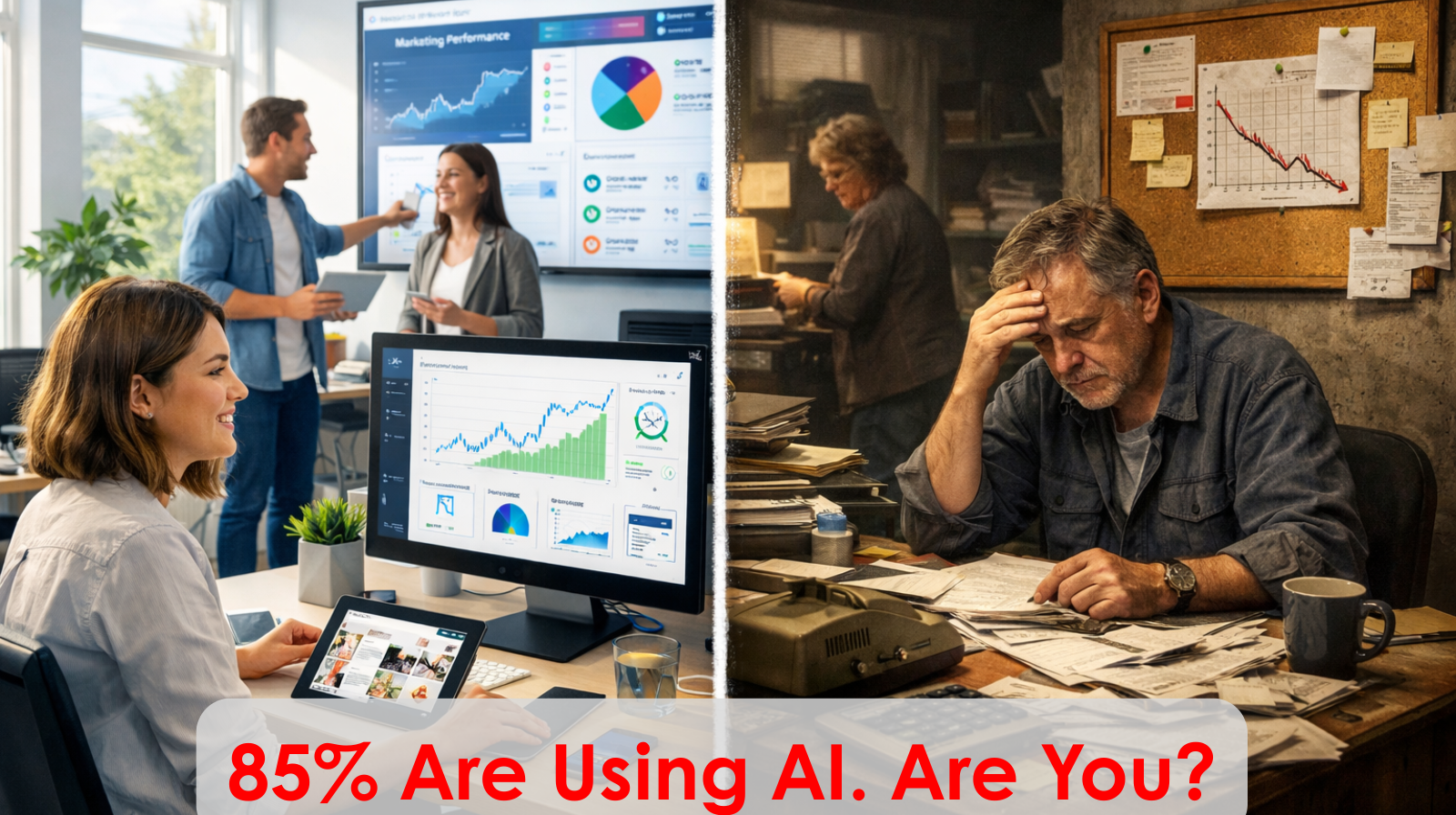
Small business marketing is experiencing a transformation that’s happening faster than most business owners realize. Recent LinkedIn research analyzing data from 18 million small businesses reveals that 85% of SMBs are already using AI in some form, while 59% of U.S. small-business executives plan to expand AI adoption across their entire organizations in 2026.
This isn’t a future trend to monitor—it’s a competitive reality reshaping your market right now. McKinsey’s State of AI 2025 research shows that 88% of organizations regularly use AI in at least one business function, with companies actively implementing AI in marketing seeing an average 30% improvement in campaign ROI.
The businesses dominating their markets in 2026 won’t be those with the biggest budgets. They’ll be the ones leveraging AI strategically to deliver customer experiences, operational efficiency, and content production that non-adopters simply cannot match.
The Perception Gap Costing SMBs Market Share
One of the most dangerous blind spots in small business today is dramatically underestimating how many competitors are already using AI. According to recent research, SMBs actively using AI overwhelmingly assume their competitors are too—because they see AI applications everywhere in their industries.
Meanwhile, businesses that haven’t adopted AI yet often believe “nobody in our sector is really using this.” This perception gap creates a false sense of security while competitors build advantages that widen daily.
The numbers tell a stark story. LinkedIn’s 2025 Small Business Report found that 45% of small businesses cite adopting new technology as their biggest opportunity for the coming year, with roughly 60% saying AI is critical to growth. More significantly, 71% of SMBs currently using AI plan to increase their investment, while only 4% intend to scale back.
These aren’t theoretical statistics—they represent real competitive advantages accumulating while others wait for “more proof” or “better timing.” The businesses scaling AI implementation now are capturing market share, improving margins, and delivering experiences that create customer expectations non-adopters struggle to meet.
Where AI Delivers Immediate Marketing ROI
Not all AI applications are created equal for small businesses. Understanding which specific use cases generate the highest returns helps SMBs prioritize limited budgets and avoid costly experimentation.
Content Creation at Scale
McKinsey’s research identifies content support for marketing strategy—including drafting, generating ideas, and presenting knowledge for creating campaigns—as one of the top three AI use cases across all business functions.
For resource-constrained SMBs, this impact is transformative. Content marketing requires consistent production across multiple channels: blog posts, social media, email campaigns, video scripts, podcast outlines. AI writing assistants now handle first drafts, generate multiple concept variations, optimize headlines for engagement, and adapt content for different platforms and audiences.
The practical result? SMBs produce in hours what previously required days or weeks, without proportionally increasing costs. Businesses combining AI-assisted content planning with professional production achieve far higher content volumes while maintaining the quality and authenticity that drives conversions.
Predictive Analytics and Smart Targeting
The shift from demographic targeting to predictive, intent-based targeting represents one of AI’s most powerful marketing applications. Traditional approaches segment audiences by age, location, and interests. AI analyzes actual behavior patterns to predict which specific individuals are most likely to convert.
For SMBs competing against larger companies with bigger marketing budgets, this precision becomes a critical equalizer. Instead of wasting ad spend on broad audiences, AI helps identify and focus exclusively on high-intent prospects—dramatically improving return on ad spend.
Recent industry analysis shows AI transforms digital advertising through predictive audience targeting, real-time bid optimization, dynamic content personalization, and automated performance reporting. Advertisers using predictive AI to anticipate user intent consistently outperform traditional demographic targeting approaches.
24/7 Customer Service Without Staffing Costs
AI-powered customer service ranks among the most common implementations according to McKinsey, encompassing contact-center automation, round-the-clock chatbot support, and intelligent response systems.
The practical impact for SMBs is significant. Traditional customer service requires staffing during business hours, with inquiries outside those windows going unanswered until the next day. AI chatbots handle basic service requests around the clock, ensuring no prospect or customer faces delays during their buying journey.
Modern AI customer service analyzes conversation history, understands context and intent, routes complex issues to human team members, and learns from each interaction to improve future responses. This frees your team to focus on high-value interactions requiring genuine human judgment and empathy, while AI ensures every routine inquiry receives immediate, accurate responses.
Campaign Optimization in Real Time
AI’s ability to analyze vast amounts of data quickly makes it invaluable for campaign optimization. Traditional testing requires manually creating variations, running experiments for statistically significant periods, analyzing results, and implementing changes—a process consuming weeks or months.
AI accelerates this dramatically. Advanced systems analyze behavior patterns, test hypotheses in real time, and predict conversions with high accuracy. Research shows ad campaigns with automated optimization deliver 30% better cost per acquisition compared to traditional manual methods.
This speed matters because marketing conditions change constantly. Consumer preferences shift, competitors launch new campaigns, seasonal factors affect behavior, and platform algorithms update frequently. AI adapts to these changes in real time rather than reacting weeks later when human analysis finally catches up.
What Separates High Performers from Everyone Else
McKinsey’s research reveals a troubling pattern: AI high performers—representing about 6% of organizations—are pulling dramatically ahead of competitors, while most organizations struggle with limited implementation delivering minimal results.
High performers share distinct characteristics. They’re more than three times more likely to use AI for transformative business change rather than just incremental improvements. These companies set growth and innovation as AI objectives beyond simple cost reduction and efficiency gains.
The scale difference is striking. High performers use AI across significantly more business functions than peers—particularly in marketing and sales, strategy and corporate finance, and product development. They commit more than 20% of their digital budgets to AI technologies, compared to much smaller investments by competitors.
Most importantly, high-performer leadership demonstrates visible ownership and commitment to AI initiatives. Senior leaders actively engage in driving adoption, role modeling AI use, and championing integration across the organization. This top-down support proves essential—organizations with strong leadership commitment are three times more likely to see meaningful AI impact.
For SMBs, this research offers crucial guidance: crowdsourcing AI experimentation across your team rarely produces transformative results. Instead, leadership must identify specific high-value opportunities, commit adequate resources, and drive strategic implementation rather than scattered pilots.
The $6.6 Trillion Economic Shift
The economic stakes around AI adoption are staggering. LinkedIn’s analysis estimates that generative AI could unlock up to $6.6 trillion in productivity gains across major economies, with small and medium-sized businesses potentially capturing more than 30% of that value depending on the country.
For individual SMBs, this translates to measurable competitive advantages. The AI in marketing market is projected to reach $107.5 billion by 2028, growing at a 36.6% compound annual growth rate. This explosive growth creates opportunities for businesses at any adoption stage—but only if they move decisively.
The key is understanding that AI adoption isn’t binary. You don’t need enterprise-level AI infrastructure to compete. Small, focused implementations in high-impact areas deliver immediate value while building organizational capability for more ambitious applications later.
Overcoming the Top 4 AI Adoption Barriers
Despite overwhelming evidence of AI’s competitive necessity, many SMBs hesitate. Understanding and addressing the most common barriers accelerates implementation and improves outcomes.
Barrier 1: “We Don’t Have Technical Expertise”
The belief that AI requires data science teams or engineering resources is the most persistent obstacle. While this was true for early AI applications, modern tools are specifically designed for non-technical users. Tools like Jasper AI for content creation, Tidio for customer service chatbots, and Google Workspace’s AI features for productivity require zero coding knowledge.
The solution is starting with accessible, user-friendly applications rather than attempting to build custom AI systems. Focus on tools that integrate with platforms you already use and provide intuitive interfaces.
Barrier 2: “AI Is Too Expensive”
Cost concerns often stem from confusing enterprise AI infrastructure with SMB-appropriate tools. While building proprietary AI systems requires significant investment, leveraging existing AI platforms costs remarkably little. Many AI marketing tools operate on subscription models starting at $50-200 monthly—comparable to other essential business software.
The relevant calculation compares AI tool expenses against the human time and opportunity costs they replace. If an AI writing assistant saves 10 hours weekly of content creation time, the math overwhelmingly favors AI adoption for nearly every SMB.
Barrier 3: “We’re Worried About Quality”
Legitimate concerns about AI-generated content quality often prevent adoption. The key insight: AI shouldn’t replace human judgment—it should augment it. Use AI to generate first drafts, then apply human expertise to refine, fact-check, and add strategic insights.
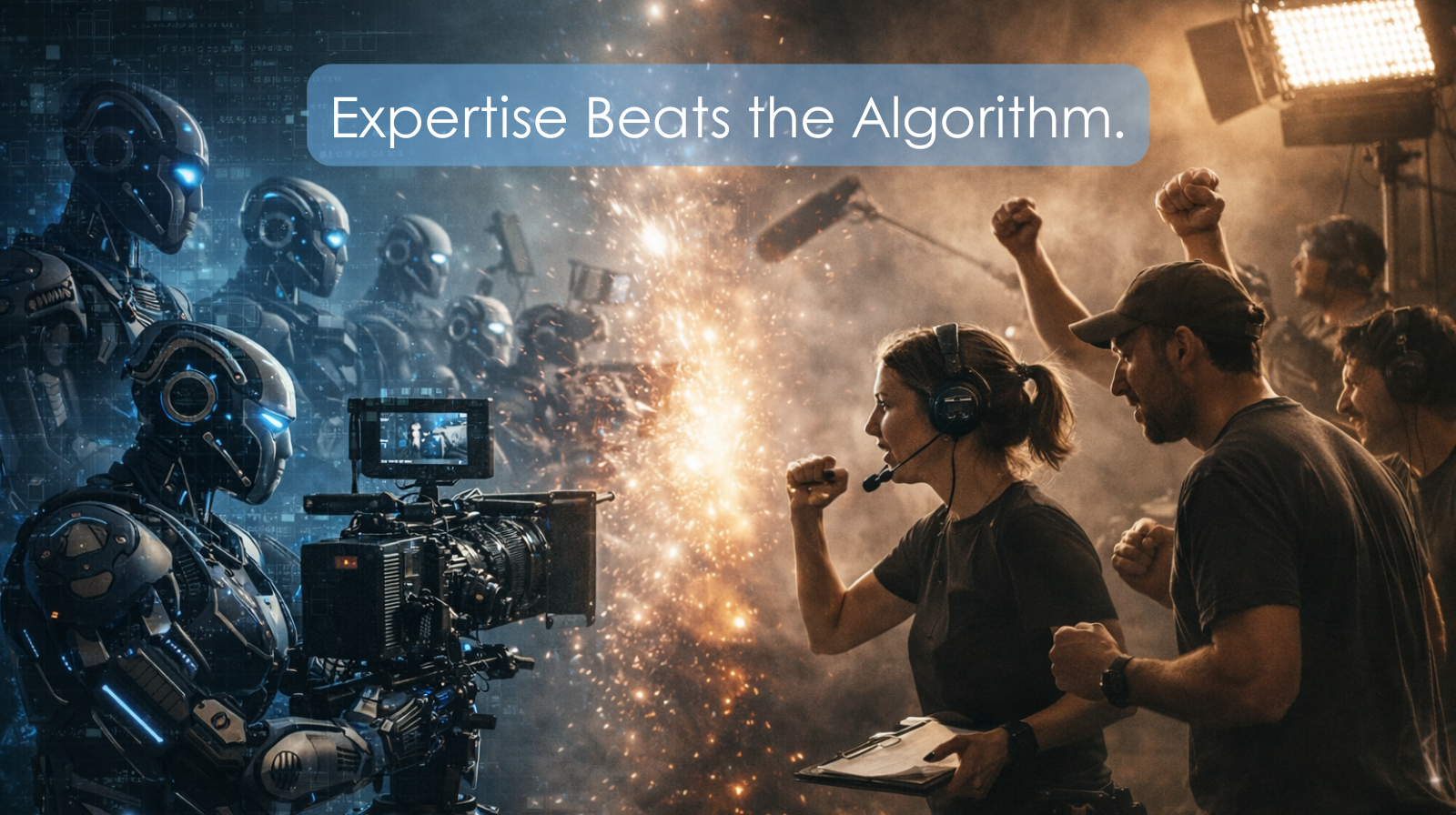
This hybrid approach combines AI’s speed and scale with human creativity and accuracy. At Q’dUp, we use AI extensively for content planning, ideation, and optimization—but our award-winning production team brings the human creativity, strategic thinking, and authentic storytelling that actually converts audiences into customers.
Barrier 4: “We Don’t Know Where to Start”
Feeling overwhelmed by options is perhaps the most common barrier. With hundreds of AI tools available and new ones launching constantly, choosing where to begin seems paralyzing.
Start with readiness assessment: identify priority areas where AI may create measurable improvements, evaluate current processes and pain points, assess data quality and availability, and determine realistic budget and timeline. Rather than attempting comprehensive transformation, start with one or two high-value applications, measure results rigorously, refine your approach, and then expand to additional use cases.
Your 90-Day AI Implementation Roadmap
Based on successful AI adoption patterns, here’s a practical roadmap SMBs can follow to implement AI strategically in early 2026.
Days 1-30: Foundation and Quick Wins
Begin by identifying the single biggest marketing bottleneck consuming disproportionate time or budget. Common candidates include content creation, social media management, customer inquiry responses, or ad campaign optimization.
Select one accessible AI tool addressing this specific bottleneck. Implement with clear success metrics—if testing AI content creation, measure time savings, content volume increases, and engagement metrics compared to baseline.
Run this pilot for 4-6 weeks, gathering both quantitative data and qualitative team feedback. Document learnings rigorously: what worked, what didn’t, and what unexpected challenges emerged.
Days 31-60: Scaling Initial Success
Based on initial results, either expand the successful pilot or pivot to a different application if results disappointed. If expanding, systematize the process by moving from experimental use to standard workflow integration.
Add a second AI application in a different functional area. If the first phase focused on content creation, the second might address customer service chatbots or predictive analytics. This diversification builds organizational AI literacy while reducing dependence on any single tool.
Days 61-90: Integration and Optimization
Focus on integrating multiple AI tools into cohesive workflows. Research shows the highest-performing organizations use AI across multiple interconnected functions rather than isolated pilots.
Optimize based on accumulated data. Which content types perform best? Which customer inquiries are AI handling effectively versus those requiring human intervention? Where are the remaining bottlenecks?
Invest in team training. While organizations invest in AI at record levels, employee adoption often lags. Closing this gap requires training, support, and mindset shifts.
Maintaining the Human Touch
The most successful AI implementations amplify rather than replace human capabilities. Industry analysis emphasizes that marketers must balance automation with human creativity—because marketing without the human touch loses the authenticity that drives conversions.
This balance matters intensely for SMBs. Your competitive advantage isn’t matching enterprise budgets—it’s delivering personalized attention, authentic relationships, and genuine expertise that automated systems cannot replicate.
AI should handle repetitive, time-consuming tactical work: generating first drafts, analyzing data patterns, optimizing campaign variables, responding to routine inquiries, and scheduling content distribution. This frees your team for strategic work requiring uniquely human capabilities like brand strategy, creative concept development, relationship building, complex problem-solving, and ethical judgment.
Q’dUp’s on-site content creation approach exemplifies this philosophy. We use AI extensively for planning, optimization, and repurposing—but our award-winning production quality comes from human storytellers, cinematographers, and audio engineers who bring authentic brand stories to life in ways no AI can replicate.
The businesses winning in 2026 won’t be those that automate everything—they’ll be those that strategically combine AI efficiency with human creativity and judgment to deliver results neither could achieve alone.
Frequently Asked Questions
How quickly can SMBs realistically see results from AI implementation?
Basic AI tool implementation typically takes 2-4 weeks from selection to initial results. Chatbots can be deployed within days, while content creation AI requires 1-2 weeks of brand voice training. Most SMBs see measurable efficiency gains within the first month, with ROI typically breaking even around month three as teams optimize their usage patterns.
Do we need technical expertise to use AI marketing tools?
Modern AI marketing tools are specifically designed for non-technical users. Platforms like Jasper, Tidio, and HubSpot require no coding knowledge and offer intuitive interfaces similar to other business software you already use. The learning curve is comparable to adopting any new marketing platform—measured in hours or days, not months.
How do we choose between the hundreds of AI tools available?
Start by identifying your single biggest marketing bottleneck, then research tools specifically addressing that problem. Read reviews from businesses similar to yours, test free trials before committing, and prioritize tools that integrate with your existing platforms. Avoid adopting multiple tools simultaneously—start with one, prove its value, then expand strategically.
What about data privacy and security concerns?
Legitimate concerns require due diligence. Use AI tools from established providers with clear privacy policies, ensure tools comply with relevant regulations, avoid uploading sensitive customer data to third-party AI platforms, and review terms of service regarding how your data trains AI models. Most reputable AI marketing tools maintain strong security standards comparable to other business software.
How do we measure whether AI investments are delivering ROI?
Establish baseline metrics before implementing AI—time spent on tasks, content volume produced, response times, conversion rates. Track the same metrics after implementation. Calculate cost savings from efficiency gains, measure revenue impact from improved targeting or personalization, and assess qualitative factors like team satisfaction and customer feedback. Most successful adopters see 20-40% efficiency improvements within the first quarter.
Key Takeaways: Your 2026 AI Action Plan
The competitive landscape shifts dramatically as 85% of SMBs integrate AI into their marketing operations. Businesses thriving in 2026 moved decisively while competitors waited for “more proof.”
AI delivers immediate ROI in content creation, predictive targeting, customer service automation, and campaign optimization. Start with one high-impact application rather than attempting comprehensive transformation immediately. SMBs can capture substantial portions of AI’s $6.6 trillion productivity opportunity through focused, strategic implementation.
The human element remains essential—AI should amplify creativity and strategic thinking, not replace it. The winning formula combines AI efficiency with human judgment and authenticity.
Most importantly: start now. Every month of delay widens the competitive gap as rivals build AI capabilities, optimize implementations, and capture market share through superior efficiency and customer experiences.
Transform Your Marketing with AI-Powered Content
You understand the urgency. You recognize that AI adoption isn’t optional for 2026 competitiveness. The question now is implementation: how do you deploy AI strategically while maintaining the quality and authenticity that differentiate your brand?
Q’dUp solves this exact challenge through our hybrid approach combining cutting-edge AI optimization with award-winning human production quality. We use AI extensively for content planning, research, optimization, and repurposing—but our professional production team delivers the authentic storytelling, visual excellence, and strategic positioning that actually convert audiences into customers.
Our on-site content creation model amplifies AI’s efficiency advantages. Instead of producing content sporadically throughout the year, our team captures 3-4 months of professional video and podcast content during just a few days of focused on-site production. We then leverage AI to optimize this content for search, repurpose it across multiple channels, and maximize ROI from every piece we create.
Ready to compete in 2026 with an AI-optimized content strategy that drives measurable results?
Book a complimentary 30-minute strategy session where we’ll analyze your current marketing approach, identify the highest-impact opportunities for AI integration, and show you exactly how our hybrid AI-human production model can transform your content marketing into a predictable lead generation system.
Schedule Your Free AI Strategy Session
Limited January strategy sessions available for SMBs serious about leveraging AI to compete effectively in 2026 and beyond.