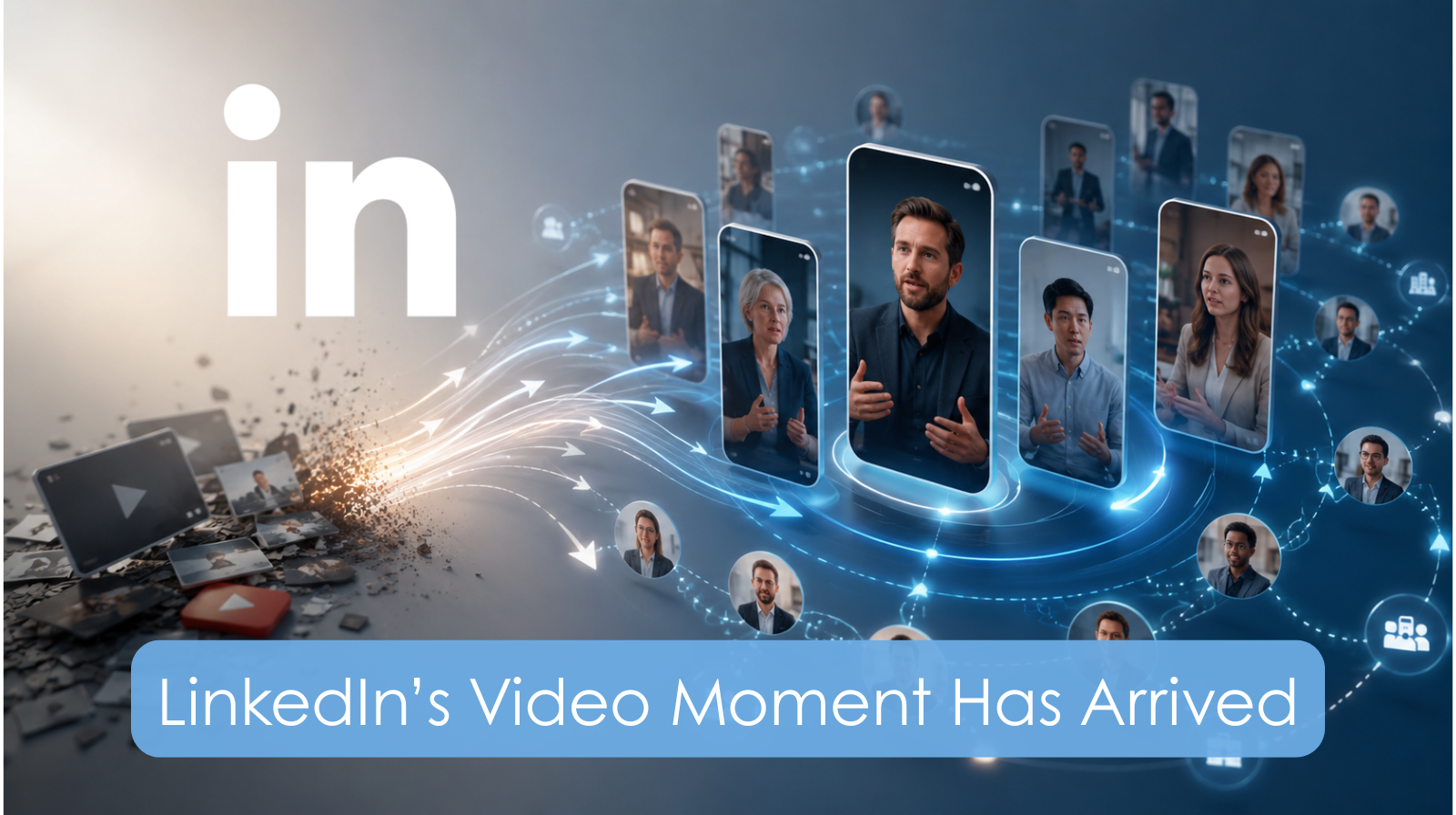
Something shifted in B2B marketing this spring, and the numbers are impossible to ignore. For the first time ever, LinkedIn has surpassed YouTube as the top video platform for businesses (Wistia State of Video 2026) — and the gap is growing faster than anyone predicted.
If your small business has spent the last few years optimizing a YouTube channel, this is not an alarm bell. YouTube still matters. What it is, however, is a clear signal that the B2B audience has relocated, the algorithm favors a new format, and the window for early-mover advantage is open right now.
This post breaks down exactly what changed, why it matters specifically for SMB decision-makers, and the concrete steps you can take this week to capitalize on LinkedIn’s B2B video dominance — without building a Hollywood production studio.
Why LinkedIn Overtook YouTube for B2B Video in 2026
The headline statistic from the Wistia 2026 State of Video Report is striking: 81% of businesses now name LinkedIn as their primary video channel, up more than 33 percentage points in just two years. YouTube trails at 76%. That reversal represents one of the fastest documented shifts in platform preference the B2B marketing world has seen.
Three converging forces drove this change. First, LinkedIn’s algorithm began heavily rewarding native video in 2024, pushing video posts to 5x more engagement than static updates. Second, the platform’s professional audience — the exact decision-makers SMBs need to reach — increasingly expects video content as part of the trust-building process. Third, short-form vertical video arrived on LinkedIn, and the numbers behind it are remarkable: vertical format earns 34% higher dwell time compared to traditional square-format content.
The audience composition makes the difference, too. YouTube’s 2.7 billion monthly users skew toward entertainment and how-to searches. LinkedIn’s 1 billion professional members are actively evaluating vendors, researching solutions, and making purchasing decisions. When your target customer is a business owner, marketing manager, or department head, that distinction changes everything about where your video dollar should go.
What This Shift Actually Means for Small Businesses
The implications for SMBs are more immediate than most realize. Consider the distribution gap: the Wistia 2026 State of Video Report found that 67% of marketing teams post social video clips on LinkedIn, while only 41% do the same on YouTube. That 26-percentage-point gap reveals where your competitors are showing up — and where you’re invisible if you’re not.
Budget context matters here. The same Wistia report notes that only 40% of teams plan to increase their video spend in 2026, down from 57% just two years prior. Nearly half are keeping budgets flat or cutting. The constraint is capacity and cost, not intent. SMBs that crack the LinkedIn video equation with efficient production will outpace larger competitors who are producing more but targeting the wrong platform.
There’s also a significant SEO and discovery dimension. LinkedIn video content indexes in Google search results, meaning a well-optimized video post can generate organic search traffic in addition to platform reach. That dual-channel effect is something YouTube offers too, but LinkedIn’s professional context produces much higher intent-to-purchase signals for B2B queries.
For health practices, professional service firms, fitness studios, and local businesses trying to establish credibility with other business owners, LinkedIn video is no longer optional. It’s the trust infrastructure that converts cold connections into warm conversations.
How to Build a LinkedIn Video Strategy That Actually Works for SMBs
Most small businesses approach LinkedIn video the wrong way: they repurpose YouTube content by letterboxing it into square format and posting it with minimal context. The platform’s algorithm actively deprioritizes this approach. Effective LinkedIn video strategy in 2026 follows a different logic.
1. Lead With Vertical Short-Form (Under 60 Seconds)
Vertical video (9:16 aspect ratio) earns the 34% dwell-time advantage because it dominates the mobile screen. According to LinkedIn Creative Labs research published in early 2026, video viewership on the platform surged 36% in 2024, reaching 154 billion views, and mobile-first consumption patterns shape how those views are distributed. Your first video investment should be short-form clips under 60 seconds that either answer a specific question your buyers ask, share a quick insight from your industry, or tease a longer conversation. Hook viewers in the first three seconds — that’s the window before the scroll.
2. Prioritize Native Uploads, Not Links
Sharing a YouTube link inside a LinkedIn post signals that you want people to leave LinkedIn. The platform penalizes outbound links in the feed by reducing reach significantly. Native video uploads — files uploaded directly to LinkedIn — stay in the feed, autoplay silently, and accumulate the engagement signals the algorithm rewards. This single change, moving from sharing links to uploading files directly, can improve reach by a measurable margin within two to three weeks.
3. Batch Your Content Production
The capacity constraint Wistia identified — flat budgets, rising demand — is especially acute for SMBs. The businesses solving this challenge are not producing one video at a time. They’re capturing multiple pieces in concentrated sessions and repurposing the material across platforms and formats. A single two-hour on-site recording session can yield four to six short-form clips, two or three longer educational pieces, and audio excerpts suitable for podcast promotion.
This is precisely how Q’dUp’s on-site production model is structured: a focused two-to-three-day engagement that produces three to four months of multi-format content. Rather than scheduling piecemeal recording sessions that drain time and energy, clients walk away with a content library ready for systematic deployment across LinkedIn, YouTube, podcast platforms, and their website.
4. Use Captions on Every Video
LinkedIn autoplay is muted by default. According to Sprout Social’s 2026 social video statistics, the overwhelming majority of social video is consumed without sound — which means captions are not an accessibility feature, they’re a conversion tool. Every word your speaker says needs to appear on screen. The Wistia 2026 State of Video Report reinforces this: AI-assisted teams are 82% more likely to offer subtitles across their videos, directly linking accessibility practices to competitive advantage.
5. Measure Beyond Views
View counts are a vanity metric on LinkedIn. The meaningful signals are average watch time, 50% and 75% completion rates, profile visits generated from a video post, and direct messages or connection requests triggered by the content. LinkedIn’s video analytics dashboard provides quartile completion data that reveals exactly where viewers stop watching — which is your editorial roadmap for the next video.
The Production Challenge Most SMBs Face — and How to Solve It
Here is the tension at the center of the LinkedIn video opportunity: the platform rewards consistency and volume, but most small businesses lack the production infrastructure to deliver either. The businesses that will win the LinkedIn video game in 2026 are not the ones with the biggest budgets. They are the ones with the most efficient content creation systems.
Q’dUp’s award-winning on-site content marketing approach was built specifically for this constraint. Rather than asking busy SMB owners and marketing managers to carve out time for ongoing video production, the process compresses the entire content creation cycle into a focused on-site engagement. The result is a fully populated content library — vertical clips for LinkedIn, long-form educational pieces for YouTube, audio content for podcast distribution, and supporting blog material — produced in days, not months.
This Week’s AI Insight: LinkedIn Video Marketing
How AI Is Reshaping LinkedIn Video Strategy for SMBs Artificial intelligence is accelerating the LinkedIn video opportunity for small businesses — but perhaps not in the way most people expect. According to the Wistia 2026 State of Video Report (wistia.com/learn/marketing/video-marketing-statistics), AI adoption in video workflows has matured to 38% of marketing teams, with the clearest gains happening in pre-production: planning, scripting, and ideation. Teams using AI in these phases are 82% more likely to produce accessible, caption-rich video. A separate Mediaocean 2026 Advertising Outlook Report (January 2026)found that 54% of marketers plan to increase AI media spend, while 42% cite data quality issues as a brake on broader implementation. The pattern for SMBs is instructive: AI works best as a strategic amplifier in the planning and distribution phases, not as a replacement for on-camera expertise and authentic human presence. According to Wyzowl’s 2026 State of Video Marketing report, 82% of video marketers say video delivers a positive ROI, and 52% of B2B marketers specifically name video their top-performing content format. The SMBs capturing those returns combine AI-assisted content planning with professionally produced footage — using technology to be more strategic and human expertise to be more credible.
Frequently Asked Questions
Is LinkedIn or YouTube better for small business video marketing in 2026?
For B2B-focused small businesses targeting decision-makers, LinkedIn is now the stronger platform. Wistia’s 2026 State of Video Report confirms 81% of businesses use LinkedIn as their primary video channel versus 76% for YouTube. LinkedIn’s professional audience, combined with 5x engagement advantage for native video, makes it the higher-ROI choice for B2B SMBs. YouTube remains valuable for SEO-driven search content, product demonstrations, and long-form educational material.
What type of LinkedIn video content performs best for small businesses?
Short-form vertical video under 60 seconds earns 34% higher dwell time on LinkedIn. Educational content that answers a specific buyer question, thought leadership clips from founders or subject-matter experts, and behind-the-scenes production content consistently outperform promotional posts. Native uploads perform significantly better than shared YouTube links, which the LinkedIn algorithm deprioritizes.
How often should an SMB post video on LinkedIn?
Consistency matters more than frequency. Most SMBs see measurable engagement growth by posting two to three native video pieces per week. The practical solution to sustaining this pace is batch production: capturing multiple videos in a single session and scheduling them for systematic release. This approach eliminates the week-to-week production burden while maintaining the algorithm-favored consistency that drives reach.
Should SMBs abandon YouTube and focus entirely on LinkedIn?
No. LinkedIn and YouTube serve different stages of the buyer journey and different search behaviors. YouTube excels at SEO-driven discovery, long-form educational content, and product demonstrations. LinkedIn dominates for professional networking, trust-building with B2B buyers, and decision-stage engagement. The most effective SMB video strategy uses batch-produced content deployed across both platforms, with format adjustments for each. A single filming session can yield content optimized for both channels.
How can Q’dUp help my small business take advantage of LinkedIn video marketing?
Q’dUp’s on-site production model is specifically designed to solve the capacity and consistency challenges that prevent most SMBs from executing a sustainable LinkedIn video strategy. Our award-winning team records at your location over two to three days, capturing everything needed for three to four months of multi-format content — including short-form vertical clips optimized for LinkedIn, long-form YouTube content, and podcast-ready audio. Visit qd-up.com/contact-us to schedule a complimentary strategy session and see how this works for your business.
Key Takeaways
- LinkedIn is now the #1 B2B video channel: 81% of businesses confirm it, up 33 points in two years.
- Native video earns 5x more engagement than static LinkedIn posts — upload directly, never share YouTube links.
- Short-form vertical video (9:16) generates 34% higher dwell time on LinkedIn — this should be your production priority.
- Batch production solves the consistency problem: capture multiple pieces in one session and deploy systematically.
- AI accelerates planning and scripting, but authentic on-camera expertise remains the trust signal that converts B2B buyers.
The LinkedIn video opportunity is not a trend to track. It’s a structural shift in where B2B buyers discover, evaluate, and trust the businesses they work with. The window for early-mover advantage is open now — but it won’t stay open indefinitely as more SMBs adapt.
Ready to Build Your LinkedIn Video Content Engine? Book a complimentary 30-minute strategy session with the Q’dUp team. We’ll analyze your current video presence, map a multi-platform content approach, and show you exactly how our on-site production model can deliver three to four months of LinkedIn-ready video in just a few days. Capacity is limited — secure your strategy session at qd-up.com/contact-us.