Your blog alone is no longer enough. Neither is your podcast operating in isolation, or your YouTube channel standing as a single channel. In 2026, AI-powered search engines do not simply rank the best article on a topic. They assemble answers from multiple content formats and surface businesses that show up across video, audio, and text simultaneously.
For SMB owners and marketing managers already stretched thin, that reality can feel daunting. Constant Contact’s Q1 2026 Small Business Now report found that 74% of SMB owners expect to spend more time on marketing this year, while 68% plan to increase their budgets. The competitive intensity is rising. If you have been relying on a single content format to drive visibility and leads, you are likely watching search traffic flatten while competitors who publish across formats pull ahead in AI Overviews, ChatGPT results, and Perplexity citations.
The good news is that a multi-modal content strategy does not require three separate teams or three separate budgets. Done correctly, it requires one focused production session and a systematic approach to turning that session into assets that work across every format AI search engines prefer.
This guide walks through what multi-modal content strategy actually means in 2026, why AI search rewards it specifically, and how SMBs can build a practical framework that drives visibility and qualified consultation bookings without burning out your team.
Why AI Search Changed the Rules for SMB Content Visibility
AI Overviews from Google now appear on nearly half of all search queries, reaching an estimated 2 billion monthly users, according to Averi.ai’s March 2026 State of AI in Marketing benchmarks report. That same report found that AI search visitors convert at 4 to 5 times the rate of traditional organic traffic, meaning the audience arriving through AI search results is measurably higher quality.
Meanwhile, ChatGPT processes 2.5 billion prompts every single day as of early 2026, with Perplexity, Gemini, and Bing Copilot all actively pulling content from across the web to construct answers users consume directly inside the search interface. The companies appearing in those answers are not winning because they ranked for a keyword. They are winning because AI engines found their content credible, comprehensive, and available in the formats those engines prefer.
This shift has created a new visibility dynamic. Traditional SEO rewarded the best single document for a given keyword. AI search rewards the most comprehensive, trusted, and multi-format presence on a topic. When an AI engine assembles an answer about podcast marketing for small businesses, it draws from transcripts, video descriptions, audio metadata, structured text, and cited statistics across multiple content types. A business that publishes in only one format hands AI systems a narrow, incomplete picture of its expertise.
The Multi-Modal Advantage in Practice
The practical advantage of publishing across formats is not theoretical. Businesses that produce video, podcast, and written content on the same topic cluster give AI engines more citation opportunities, more signals of topical authority, and more reasons to surface that brand in generated answers. Nearly 9 in 10 online buyers report wanting brands to produce more video content, and research consistently confirms that multimedia content has become a direct factor in getting found across both search and social channels in 2026, not merely a supplement to text.
What Multi-Modal Content Strategy Actually Means for Your Business
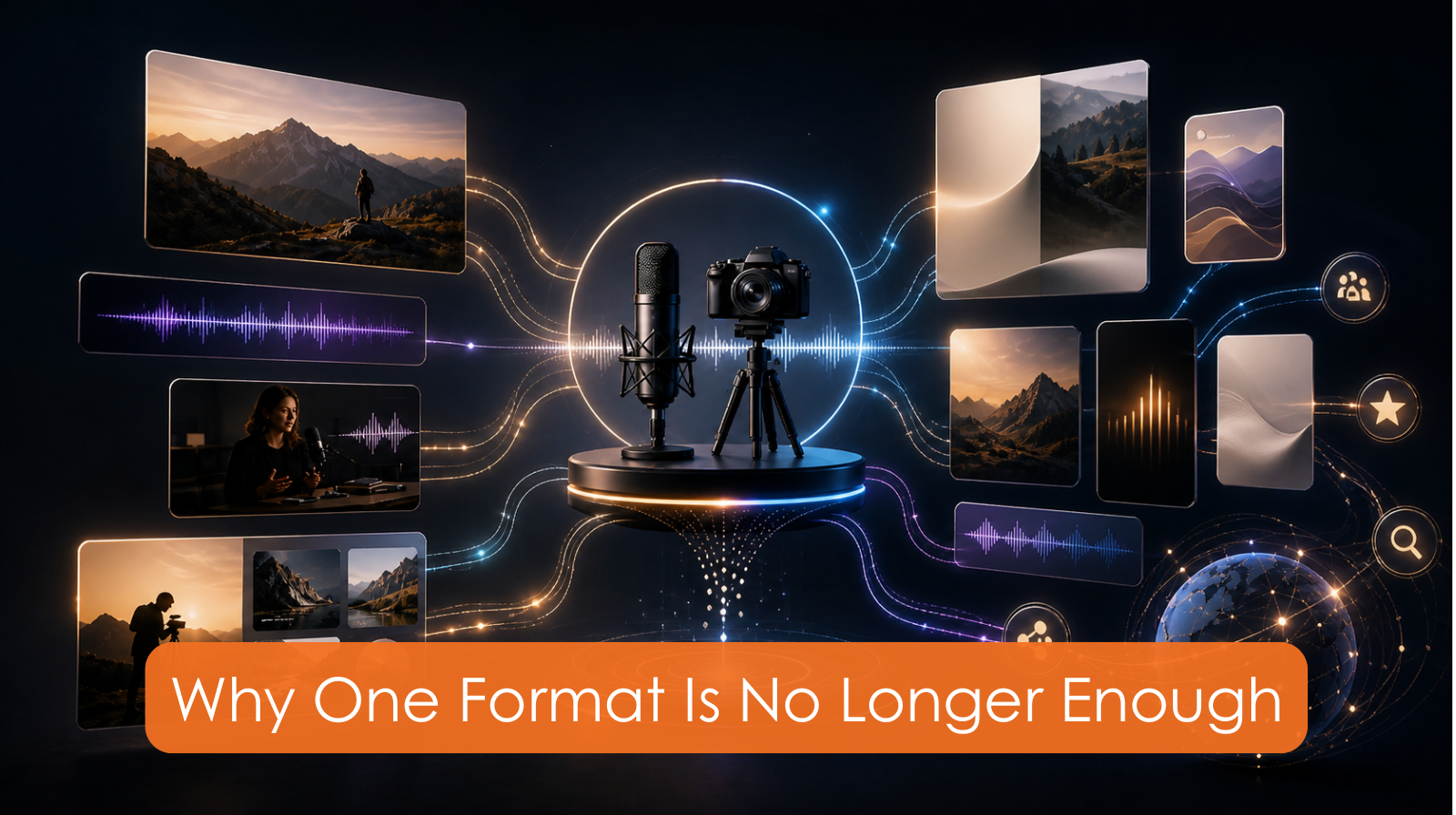
Multi-modal content strategy is not about being everywhere or producing maximum volume. It is about publishing coordinated content across video, audio, and written formats that collectively answer the questions your audience is asking, across every platform where AI and human searchers look for answers.
Think of it as a three-layer content system where each format serves a distinct role in how AI engines and human audiences discover and evaluate your business.
Layer 1: Video Content as Your Authority Signal
Video content has become one of the strongest authority signals for AI search systems. Google’s AI Overviews regularly cite video content in generated answers. WordStream’s 2026 AI Marketing Trends analysis identifies multi-modal marketing as one of the defining shifts of 2026, noting that businesses publishing structured content in multiple formats make themselves considerably easier for AI systems to interpret, recommend, and cite.
The audience-side data reinforces this direction: nearly 95% of internet users watch video content every month. For SMBs, a professionally produced educational or explainer video on a core service topic is not just a marketing asset. It is a citation-building document that increases your probability of appearing in AI-generated answers on that subject. Short-form clips extend that reach further across YouTube Shorts, Instagram Reels, and LinkedIn video.
Layer 2: Audio and Podcast Content as Your Depth Signal
Podcast content and audio transcripts serve a different but equally important function in AI search visibility. Global podcast listenership crossed 550 million monthly listeners in 2026, confirming that audio has become a mainstream media channel, not a niche format. AI engines pull from podcast transcripts, show notes, and episode descriptions when constructing nuanced answers on specialized topics.
The SEO impact of podcast transcripts is well-documented: podcasts with searchable transcriptions see organic search traffic increases of up to 50% compared to audio-only episodes. This means a fitness studio owner who publishes a podcast episode on member retention, complete with a full transcript and structured show notes, creates a searchable, AI-citable content asset that extends well beyond its original audience.
Podcast content also builds the trust signals, consistent publishing cadence, and expert positioning that AI systems use to determine which sources to prioritize when assembling answers on specialized subjects.
Layer 3: Written Content as Your Structure Signal
Blog posts, service pages, and SEO-optimized written content remain the structural backbone of AI search visibility. They provide the clear, direct answers that AI engines extract for Featured Snippets and Overviews. They host the internal links that signal topical authority. They contain the statistics and structured data that AI systems prefer to cite.
Research consistently confirms that content containing specific statistics earns meaningfully higher visibility in AI search results compared to content without data points. Written content optimized with clear headings, FAQ sections, and direct answers continues to drive a disproportionate share of AI citations for SMB-relevant topics.
Why the Three Layers Work Better Together
Each format amplifies the others. A blog post referencing a video demonstration on the same topic gives AI engines two citation sources for one question. A podcast episode expanding on a blog topic provides depth that written content alone cannot match. A video driving viewers to a detailed written guide creates the user journey signals that tell search systems the content is genuinely valuable.
SMBs publishing all three formats on the same topic cluster build what content strategists call topical authority: the signal that your business is the most comprehensive and trustworthy source on a subject. This is the foundation that AI search engines reward with sustained visibility and higher citation rates.
How to Build Your Multi-Modal Stack Without a Separate Budget for Each Format
The practical barrier for most SMBs is not strategy. It is the assumption that producing three content formats requires three times the budget and three content teams working in parallel. That assumption is wrong, and it is costing businesses the visibility advantage that coordinated multi-modal production provides.
The most efficient approach is a single coordinated session that captures all three formats simultaneously, then distributes the resulting assets across platforms through a systematic repurposing workflow.
Step 1: Plan Around a Topic Cluster, Not Individual Pieces
Before any production begins, identify the core topic area your business needs to own in AI search. For a health and wellness practice, that might be patient education around a specific condition. For a restaurant, it might be the philosophy behind sourcing and preparation. For a B2B service provider, it might be the measurable outcomes clients achieve.
Plan video, podcast, and written content to address different facets of that same topic cluster. A podcast episode can explore the why in depth. A video can demonstrate the how. A blog post can structure the what with data and specific recommendations. Each format becomes a distinct entry point to the same authority cluster.
Step 2: Produce Video and Audio in the Same Session
Professional video and podcast production do not require separate shoots, separate studios, or separate sessions. A properly structured on-site production session can capture video and audio content simultaneously, with the resulting footage edited into format-specific assets in post-production.
This approach of capturing 3 to 4 months of content across video and podcast formats in 2 to 3 days of on-site recording is the core efficiency model that allows SMBs to maintain multi-modal publishing without proportionally increasing their content budget.
Step 3: Extract Written Content From Your Production Assets
Video transcripts, podcast show notes, and episode summaries provide a substantial foundation for written content. Rather than creating blog posts from scratch separately from video and podcast production, treat transcripts as raw material for your written layer. AI-assisted editing tools accelerate this process, helping transform a transcript into a structured, SEO-optimized blog post in a fraction of the traditional drafting time.
Common mistakes to avoid: producing each format independently with no shared source material, publishing video, podcast, and blog content on different topic areas without a unifying cluster strategy, and treating multi-modal production as additive work rather than a coordinated capture-and-distribute system.
The Q’dUp Advantage: Multi-Modal Production From One On-Site Session
Q’dUp’s on-site content creation model was designed for exactly this challenge. In a standard production engagement, the Q’dUp team arrives at your location and captures everything needed to produce 3 to 4 months of multi-modal content across video, podcast, and written formats in 2 to 3 days of structured recording sessions.
That means a single investment in professional production yields the video content needed for YouTube and social media, the podcast episodes that build authority and depth on core topics, and the raw material required to produce weeks of optimized written content. Each asset is production-ready, brand-consistent, and designed to work as a coordinated multi-modal presence.
Our award-winning video production and YouTube marketing services capture on-camera expertise that no AI-generated video can replicate, building the authority signal your brand needs to earn AI citations.
Our professional podcast production services create the depth-signal content that AI search engines and audiences reward with sustained visibility on specialized topics.
Our content marketing strategy and services ensure every format works together as a unified system, building topical authority rather than three isolated channels.
The result is a multi-modal content library built around your authentic expertise, captured with professional quality, and distributed through a strategy that compounds your AI search visibility over time.
This Week’s AI Insight: Multi-Modal Content Strategy
AI search engines are accelerating the advantage for multi-modal publishers at a pace that should concern any SMB still publishing in a single format. WordStream’s February 2026 analysis of the 8 Most Influential Content Marketing Trends confirms that multimedia content, including video, images, and interactive elements, has become a direct factor in search and social visibility, not an optional enhancement to written text. The same analysis found that 89% of online buyers want brands to produce more video content, signaling that audience preference and algorithm preference are now fully aligned. Separately, AI search visitors have been shown to convert at 4 to 5 times the rate of traditional organic traffic, meaning the audience arriving through AI-cited content is not just larger in potential, it is measurably higher-intent. The strategic implication for SMBs is significant: multi-modal content investment does not simply expand exposure, it captures a fundamentally more valuable audience. The important caution is that volume without coordination does not produce this advantage. Publishing video, podcast, and blog content on unrelated topics fails to build the topical authority that AI engines reward. A human-directed strategy with brand-consistent quality and a unified topic cluster approach is what drives compounding AI visibility over time.
Frequently Asked Questions About Multi-Modal Content Strategy for SMBs
What is multi-modal content strategy and why does it matter for small businesses in 2026?
Multi-modal content strategy means publishing coordinated video, audio, and written content on the same topic cluster rather than relying on a single format. It matters in 2026 because AI search engines, including Google AI Overviews, ChatGPT, and Perplexity, pull from multiple content formats when assembling answers. Businesses appearing in only one format are invisible to a significant portion of AI-generated search results, while businesses publishing across formats build compounding visibility that grows over time.
Should my small business create video, podcast, and blog content together for better SEO in 2026?
Yes, and the most efficient approach is producing them from the same source session rather than as separate independent projects. When video, podcast, and written content address the same topic cluster, they reinforce each other as authority signals for AI search engines. Coordinated multi-modal publishing on a unified topic outperforms the same volume of content published in isolation across unrelated subjects.
How many pieces of content can a small business realistically produce from one multi-modal session?
A properly structured 2 to 3 day on-site production session can generate enough raw material for 3 to 4 months of consistent publishing across all three formats. That typically includes multiple long-form and short-form video assets, 6 to 12 podcast episodes or episode segments, and foundational written content covering several topic cluster posts. The key is structured production planning that treats every session as a multi-format capture opportunity rather than a single-format shoot.
How does multi-modal content help a business get cited in AI search results like ChatGPT and Perplexity?
AI search systems prioritize content that is comprehensive, credible, and structured for extraction. Multi-modal content increases the number of formats available for citation, creating more entry points into AI-generated answers. A business with a video, a podcast transcript, and a blog post on the same question is significantly more likely to be cited than a business with only one of those assets. Specific statistics, direct answers to common questions, and clear heading structure further increase citation probability.
How can Q’dUp help my business build a multi-modal content strategy?
Q’dUp’s on-site production model captures video, podcast, and written content source material in a coordinated 2 to 3 day session at your location. The team handles production quality, brand consistency, and content strategy alignment across all three formats. The result is a multi-modal content library built around your authentic expertise, ready to drive AI search visibility, audience engagement, and qualified consultation bookings. A complimentary strategy session is the starting point for mapping your specific content opportunities.
Key Takeaways
- AI search engines reward multi-modal publishers with higher citation rates, better visibility, and higher-converting traffic than single-format content strategies deliver.
- Multi-modal strategy does not require three separate budgets. A coordinated on-site production session captures video, audio, and written source material simultaneously, making multi-format publishing achievable for SMBs at manageable cost.
- Each content format plays a distinct role: video builds authority signal, podcast builds depth signal, and written content builds structure signal for AI search systems.
- Topical authority is the goal. Coordinated multi-modal content on the same topic cluster compounds AI search visibility more effectively than high-volume publishing across unrelated subjects.
- Human expertise and brand authenticity remain the differentiators that AI-generated content cannot replicate, making professionally produced on-site content the highest-ROI foundation for a multi-modal strategy.
The window to build a meaningful multi-modal content advantage is still open for most SMBs. Your competitors are not yet publishing coordinated video, podcast, and written content around unified topic clusters. Businesses that establish that multi-format presence now will be the businesses AI search engines default to citing when potential customers are searching for exactly what you offer.
Ready to build a multi-modal content library that drives AI search visibility and qualified leads? Book a complimentary 30-minute strategy session with the Q’dUp team. We will review your current content presence, identify your highest-priority topic cluster opportunities, and show you exactly how our on-site production model delivers 3 to 4 months of coordinated video, podcast, and written content in just a few days.
Schedule Your Free Strategy Session at qd-up.com/contact-us/