The honest answer is that AI runs through most of our week. It just never touches the two things that decide whether the work is any good.
People tend to want one of two answers here — either “we’re all-in on AI” or “we don’t use it, everything’s handmade.” Both are marketing positions, and neither is true of anyone actually producing at volume. Here’s where it actually sits for us.
Where we use it, gladly
Before we ever roll. This is where AI earns its keep most — but not the way people assume. We don’t ask it to go find out about a guest. We gather the sources ourselves — their work, their interviews, the material that actually matters — and use AI to summarize and organize what we’ve pulled. From that we build a first pass at interview questions and a field guide for the shoot. When we walk into a room having done real homework, the host asks better questions and the guest does less of the explaining. The judgment about what’s worth reading stays with us; AI just compresses the hours of digesting it.
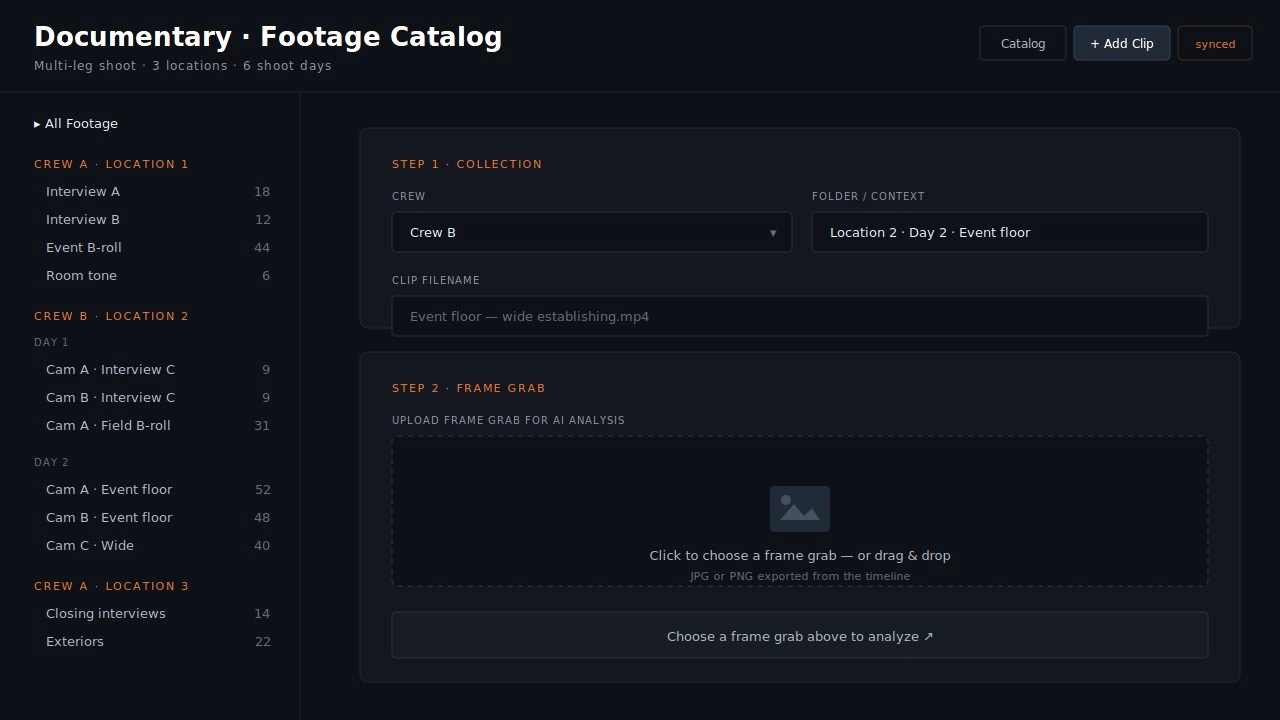
After the shoot. On a multi-leg documentary you come home with days of footage from different locations, and just knowing what you have is its own job. We use AI to help catalog and categorize that material — logging, tagging, sorting by subject and setting — so the edit starts from an organized library instead of a hard drive full of mystery. It doesn’t decide what’s good. It just makes sure nothing good gets lost.
After we publish. Transcription, captions, chapter markers, show notes, a first pass at clip suggestions. This is mechanical work that used to eat an afternoon per episode, and machines are genuinely good at it now. A transcript that’s 98% right in ninety seconds is worth more than a perfect one that takes two hours — we clean up the last two percent and move on.
On the business side. Scoping documents, first drafts of proposals, branding language, the connective tissue of running a studio. None of that is the craft. All of it is faster with a capable assistant.
Notice the pattern: AI does the work that surrounds the work. Prep, cleanup, admin. The parts where speed is the whole point and judgment isn’t.
Where we don’t, on principle
Two places. Both are the actual product.
A human decides what matters. Which moment is the one. Which question to ask next. What to cut and what to protect. We’ve tried every AI editor that promises to assemble a rough cut, and they save real time — but the cuts don’t make sense often enough that the time comes back with interest. They find the words. They don’t find the story.
Because a cut isn’t a transcript with the boring parts removed. It’s pacing. It’s building a moment against a music bed so the swell in the track lands with the turn in the story. It’s knowing that a three-second silence is the most important part of an interview and leaving it in. No tool that optimizes for “remove dead air” will ever leave that silence. We care about this more than almost anything, and it’s the last thing we’d ever hand off.
A human is accountable for the facts. A lot of our work is medical. On Life on Pause, a patient is telling their own story, and it has to be their story — not a plausible-sounding version of it. On The Skin Report, a dermatologist is making clinical claims that have to be right, sourced, and defensible. Generative tools produce confident, fluent, occasionally invented text. In a med-spa explainer or a children’s-hospital series, “occasionally invented” isn’t a rounding error. It’s the whole risk. A person owns every factual claim that goes out under a client’s name.
The flood makes the human parts worth more
There’s a lot of AI-generated video arriving right now, and the reflex in our industry is to panic about it. We read it the other way. When synthetic content is everywhere, the things it can’t do — a real person’s actual voice, a moment that happened, a story someone lived — stop being table stakes and start being the differentiator. The flood doesn’t devalue human work. It makes it the rare thing.
Which is also why we don’t treat “we use AI” and “we make human work” as opposites. We use the machines to move faster through everything that isn’t the point, so we can spend the saved hours on the parts that are.
If AI-generated content is the goal
Some clients come to us specifically wanting it — AI avatars, content produced through systems and stacks, volume at a speed no crew can match. We can build that too. It’s a real tool for a real set of goals, and pretending otherwise would be its own kind of dishonesty.
The question we ask first is the same one we’d ask about any format: what’s the story, and who’s it for? If the goal is reach and repetition, a system might be exactly right. If the goal is trust — a patient, a founder, an expert whose credibility is the product — then a real person on camera does something no avatar has managed yet. Most of the time it’s some of both, and the craft is knowing which parts are which.
What this means if you’re hiring a producer
Ask where the human judgment lives. Any shop can run the same transcription tool you can. What you’re paying for is the person who decides which ten seconds of an hour actually matter — and who puts their name on the facts. If a producer can’t tell you clearly where they stop trusting the machine, that’s the answer.